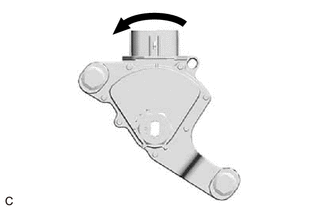
Adjustment [12/2019 - ]: Procedure
WARNING: This page is about a different variant/trim than selected.
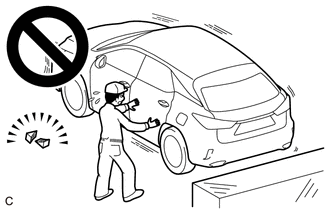
- SECURE VEHICLE
- Fully apply the parking brake and chock a wheel.
- INSPECT SHIFT LEVER POSITION SENSOR POSITION
- Turn the ignition switch to ON (READY).
- Move the shift lever to D and release the brake pedal.WARNING:
Be sure to apply the parking brake and chock all 4 wheels to secure the vehicle.
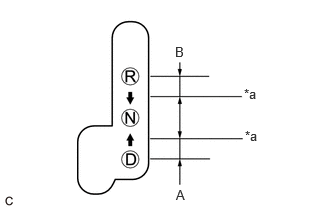
- Slowly move the shift lever to N and measure the moving distance (A) of the shift lever from the original point to the gear disengagement point.
*a Gear Disengagement Point NOTE:Be sure to move the shift lever slowly.
- Move the shift lever to R and release the brake.WARNING:
Be sure to apply the parking brake and chock all 4 wheels to secure the vehicle.
- Slowly move the shift lever to N and measure the moving distance (B) of the shift lever from the original point to the gear disengagement point.NOTE:
Be sure to move the shift lever slowly.
- Check that the moving distances (A) and (B) shown in the illustration are almost the same.
HINT:
- If the moving distances (A) and (B) are almost the same, adjustment of the shift lever position is not necessary.
- If the moving distance (A) is shorter than (B), perform step [#1] of Adjust Shift Lever Position Sensor Position.
- If the moving distance (B) is shorter than (A), perform step [#2] of Adjust Shift Lever Position Sensor Position.
- ADJUST SHIFT LEVER POSITION SENSOR POSITION
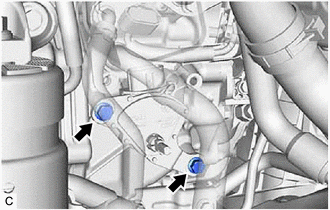
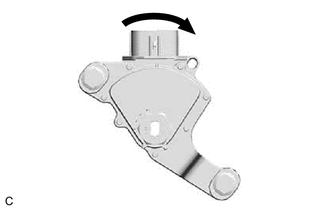
- If the moving distance (A) is shorter than (B). [#1]
HINT:
If the shift lever is moved from R to N, the moving distance of the shift lever from the original point to the gear disengagement point becomes longer.
- If the moving distance (B) is shorter than (A). [#2]
HINT:
If the shift lever is moved from D to N, the moving distance of the shift lever from the original point to the gear disengagement point becomes longer.
- If the moving distance (A) is shorter than (B). [#1]