Installation [12/2019 - ]: Procedure
- INSPECT COMPRESSOR OIL
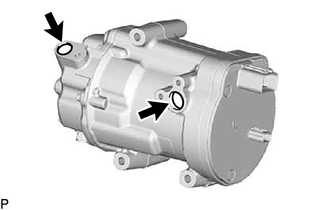
- When replacing the compressor with motor assembly with a new one, gradually discharge the inert gas from the service valve, and drain the following amount of oil from the new compressor with motor assembly before installation.
Standard
(Oil capacity inside the new compressor with motor assembly: 210 to 225 cc (7.11 to 7.60 fl.oz)) - (Remaining oil amount in the removed compressor with motor assembly) = (Oil amount to be removed from the new compressor)
NOTE:- If a new compressor with motor assembly is installed without removing some oil, there will be too much oil in the system due to the oil remaining in the pipes of the vehicle. Excessive oil in the system prevents heat exchange in the refrigeration cycle and causes ineffective cooling.
- If the amount of oil remaining in the old compressor with motor assembly is too small, check the air conditioning system for oil leaks.
- Be sure to use ND-OIL 11 or equivalent compressor oil. If any compressor oil other than ND-OIL 11 is used, compressor with motor assembly insulation performance may decrease, resulting in leakage of electric power.
- When replacing the compressor with motor assembly with a new one, gradually discharge the inert gas from the service valve, and drain the following amount of oil from the new compressor with motor assembly before installation.
- INSTALL COMPRESSOR WITH MOTOR ASSEMBLY
- Using an E8 "TORX" socket wrench, temporarily install the compressor with motor assembly with the 2 stud bolts.
Torque: 4.0 N.m (41 kgf/cm, 35 in.lbf)
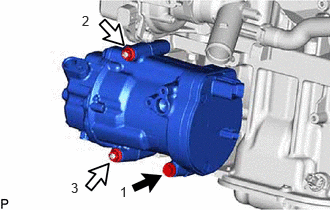
- Install the compressor with motor assembly with the bolt and 2 nuts.
 Courtesy of © TOYOTA, LICENSE AGREEMENT TMS1002
Bolt 
Nut Torque: 24.5 N.m (250 kgf/cm, 18 ft.lbf)
HINT:
Tighten the bolt and nuts in the order shown in the illustration.
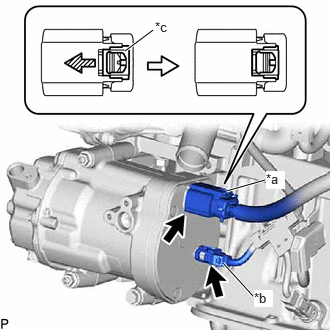
- Connect the connector (B).
*a Connector (A) *b Connector (B) *c Green-colored Lock 
Slide - Remove the insulating tape from the connector (A).
- Connect the connector (A) and slide the green-colored lock as shown in the illustration to securely lock it.WARNING:
Make sure to wear insulated gloves.
NOTE:Make sure that the connector is connected securely.
- Connect the 2 connectors.
- Using an E8 "TORX" socket wrench, temporarily install the compressor with motor assembly with the 2 stud bolts.
- CONNECT SUCTION HOSE SUB-ASSEMBLY
- Remove the vinyl tape from the suction hose sub-assembly.
- Sufficiently apply compressor oil to a new O-ring and the fitting surface of the compressor with motor assembly.
Compressor Oil
ND-OIL 11 or equivalent
- Install the O-ring to the suction hose sub-assembly.NOTE:
- Keep the O-ring and O-ring fitting surface free of foreign matter.
- Do not use any compressor oil other than ND-OIL 11 or equivalent. If any compressor oil other than ND-OIL 11 or equivalent is used, compressor motor insulation performance may decrease, resulting in leakage of electric power.
- Connect the suction hose sub-assembly to the compressor with motor assembly with the bolt.
Torque: 9.8 N.m (100 kgf/cm, 87 in.lbf)
- INSTALL DISCHARGE HOSE SUB-ASSEMBLY
- Remove the vinyl tape from the discharge hose sub-assembly.
- Sufficiently apply compressor oil to a new O-ring and the fitting surface of the compressor with motor assembly.
Compressor Oil
ND-OIL 11 or equivalent
- Install the O-ring to the discharge hose sub-assembly.NOTE:
- Keep the O-ring and O-ring fitting surface free of foreign matter.
- Do not use any compressor oil other than ND-OIL 11 or equivalent. If any compressor oil other than ND-OIL 11 or equivalent is used, compressor motor insulation performance may decrease, resulting in leakage of electric power.
- Connect the discharge hose sub-assembly to the compressor with motor assembly with the bolt.
Torque: 9.8 N.m (100 kgf/cm, 87 in.lbf)
- Install the discharge hose sub-assembly to the cooler condenser assembly with the bolt.
Torque: 5.4 N.m (55 kgf/cm, 48 in.lbf)
- INSTALL SERVICE PLUG GRIP
Refer to INSTALLATION [12/2019 - 11/2023] , or refer to INSTALLATION [11/2023 - ]
- CHARGE AIR CONDITIONING SYSTEM WITH REFRIGERANT
Refer to PROCEDURE - Step 2
- WARM UP COMPRESSOR
Refer to PROCEDURE - Step 4
- INSPECT FOR REFRIGERANT LEAK
Refer to PROCEDURE - Step 5