On-Vehicle Inspection [12/2019 - ]: Procedure
WARNING: This page is about a different variant/trim than selected.
- INSPECT FOR COOLANT LEAK (for Engine) WARNING:
Do not remove the radiator cap sub-assembly while the engine and radiator assembly are still hot. Pressurized, hot engine coolant and steam may be released and cause serious burns.
- Remove the radiator cap sub-assembly.
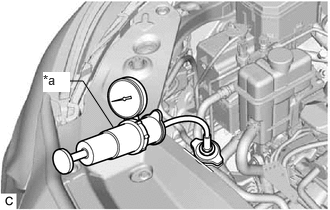
- Fill the radiator assembly with engine coolant, and then install a radiator cap tester.
*a Radiator Cap Tester - Put the engine in Inspection Mode (Maintenance Mode).
Powertrain > Hybrid Control > Utility
Tester Display Inspection Mode - Warm up the engine.
- Pump the radiator cap tester to 103 kPa (1.1 kgf/cm2
, 15 psi), and then check that the pressure does not drop.
- If the pressure drops, check the hoses, radiator assembly and engine water pump assembly (water inlet housing) for leaks.
- If there are no signs of external engine coolant leaks, check the heater core, cylinder block sub-assembly and cylinder head sub-assembly.
- Remove the radiator cap tester.
- Install the radiator cap sub-assembly.
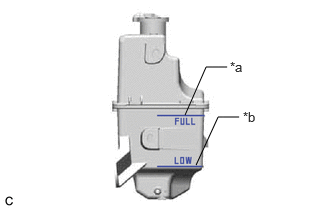
- INSPECT ENGINE COOLANT LEVEL IN RESERVOIR TANK (for Engine)
- INSPECT ENGINE COOLANT QUALITY (for Engine) WARNING:
Do not remove the radiator cap sub-assembly while the engine and radiator assembly are still hot. Pressurized, hot engine coolant and steam may be released and cause serious burns.
- Remove the radiator cap sub-assembly.
- Check if there are any excessive deposits of rust or scale around the radiator cap sub-assembly and water filler hole. Also, the engine coolant should be free of oil.
If excessively dirty, replace the engine coolant.
- Install the radiator cap sub-assembly.