Precaution [12/2019 - ]
- TROUBLESHOOTING PRECAUTION NOTE:
- Since the brake lines are critical safety related parts, be sure to disassemble and inspect the components if a brake fluid leak is found. If any abnormalities are found, replace the component with a new one.
- When removing brake components, cover the brake line connections to prevent foreign matter such as dust or dirt from entering the lines.
- Do not allow brake fluid to contact any painted surface. If brake fluid leaks onto any painted surface, immediately wash it off.
- Do not damage or deform the brake lines during the removal and installation procedures.
- When installing a brake line or flexible hose, ensure that they are free from twists or kinks.
- Do not deform the bracket or vehicle body when connecting a brake line and flexible hose.
- If the metal end of a flexible hose does not fit into the groove on the bracket, twist the hose slightly to insert it.
- Flexible hoses must be kept free from shock absorber oil, grease, etc.
- When installing a brake line to a plastic clamp, ensure that the brake line is not loose or pinched.
- Do not reuse any clips or plastic clamps removed from a flexible hose.
- After installing a brake line or flexible hose, ensure that they do not interfere with any other components or the vehicle body.
- DISCONNECTING AND CONNECTING FLEXIBLE HOSE AND BRAKE LINE
- Disconnecting:
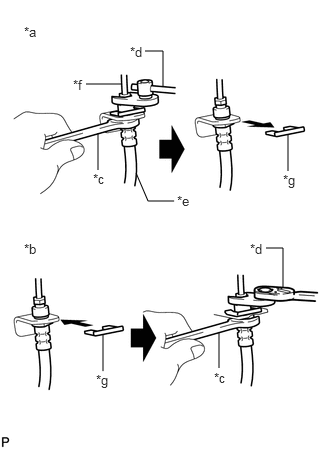
*a Disconnecting *b Connecting *c Hold *d Turn *e Flexible Hose *f Brake Line *g Clip - Hold the flexible hose with a wrench and disconnect the brake line using a union nut wrench without deforming the brake line.
- Remove the clip and disconnect the flexible hose.
- Connecting:
- Secure the flexible hose with a new clip. Be sure to securely install the clip.
- Connect the brake line using a union nut wrench without deforming the brake line.
- Disconnecting:
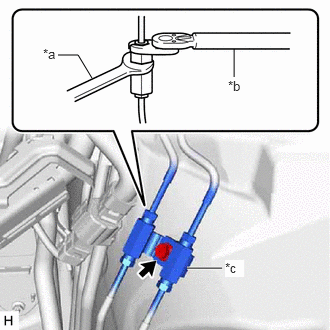
- CONNECTING BRAKE LINE AND WAY