Reassembly [12/2019 - ]: Procedure
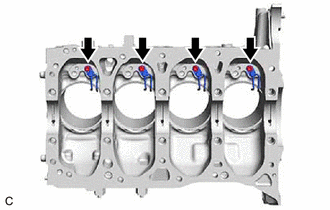
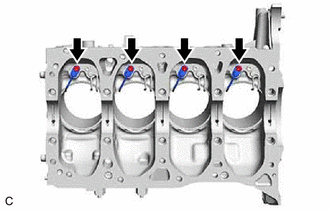
- INSTALL NO. 2 OIL NOZZLE SUB-ASSEMBLY
- INSTALL NO. 1 OIL NOZZLE SUB-ASSEMBLY
- INSTALL PISTON
- Using a screwdriver, install a new piston pin hole snap ring to the piston pin hole on the rear side of the piston.
HINT:
Tape the screwdriver tip before use.
- Gradually heat the piston to between 80 and 90°C (176 and 194°F).WARNING:
Be sure to wear protective gloves.
- Apply a light coat of engine oil to the piston, piston pin and connecting rod.
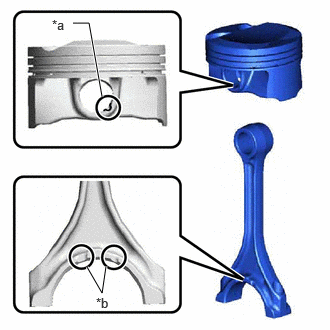
- Align the cutout of the piston and front mark of the connecting rod, insert the connecting rod into the piston, and then push in the piston pin with your thumb until the piston pin comes into contact with the piston pin hole snap ring.
*a Cutout *b Front Mark NOTE:Do not change the combination of the pistons and piston pins.
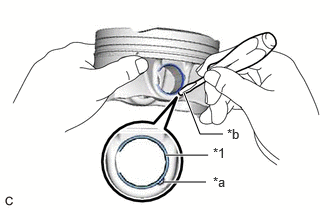
- Using a screwdriver, install a new piston pin hole snap ring to the piston pin hole on the front side of the piston.
*1 Piston Pin Hole Snap Ring *a Cutout *b Protective Tape NOTE:Be sure that the end gap of the piston pin hole snap ring is not aligned with the cutout of the piston.
HINT:
Tape the screwdriver tip before use.
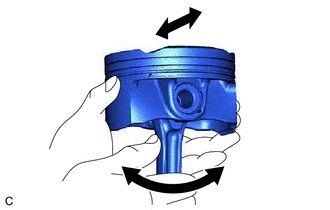
- Check the fitting condition between the piston and piston pin.
- Move the connecting rod back and forth on the piston pin. Check the fitting condition.
HINT:
If abnormal movement is felt, replace the piston and piston pin as a set.
- Rotate the piston back and forth on the piston pin. Check the fitting condition.
HINT:
- If abnormal movement is felt, replace the piston and piston pin as a set.
- Perform "Inspection After Repair" after replacing the piston.
Refer to INITIALIZATION [12/2019 - 10/2021] , or refer to INITIALIZATION [10/2021 - ]
- Move the connecting rod back and forth on the piston pin. Check the fitting condition.
- Using a screwdriver, install a new piston pin hole snap ring to the piston pin hole on the rear side of the piston.
- INSTALL PISTON RING SET
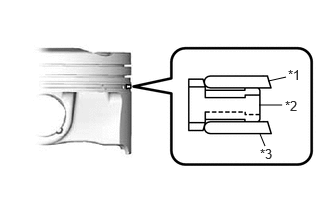
- Install the oil ring expander by hand.
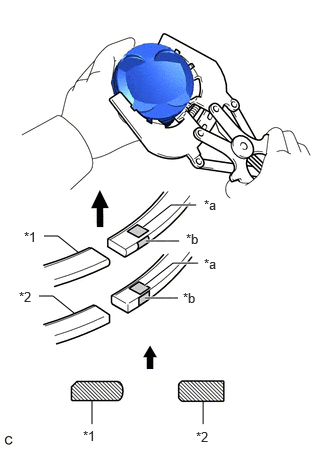
*1 Upper Side Rail *2 Oil Ring Expander *3 Lower Side Rail - Install upper side rail and lower side rail to the piston.
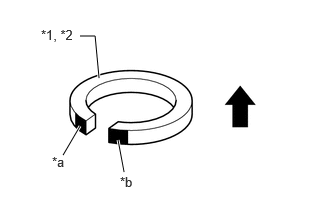
*1 Upper Side Rail *2 Lower Side Rail *a Paint (Orange) *b Paint (Light Blue) 
Upward NOTE:Make sure to install the upper side rail and lower side rail in the correct direction. Also, when installing the upper side rail and lower side rail, the oil ring expander may move and overlap. If this occurs, part of the side rail may greatly protrude.
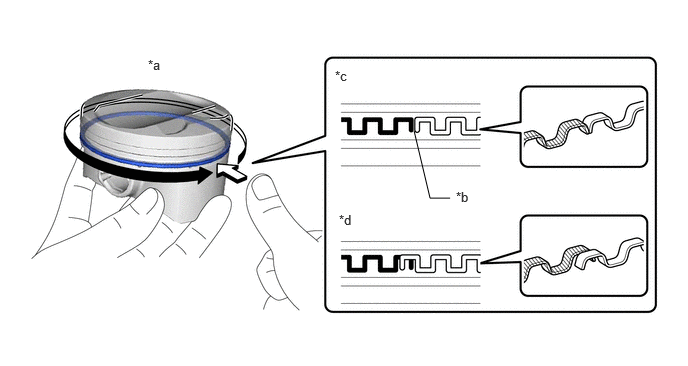
- Check that the ends of the oil ring expander are not overlapping and that the upper side rail and lower side rail are securely installed into the groove.
*a Press around the circumference *b Ring End *c Correct *d Incorrect (Ends of the oil ring expander are overlapping) NOTE:- After installing the oil ring expander, upper side rail and lower side rail, press around the circumference with a finger to check that they are securely installed into the groove.
- If the oil ring expander is not securely installed into the groove, check that the ends of the oil ring expander are not overlapping.
- If the ends of the oil ring expander are overlapping, remove the upper side rail and lower side rail and realign the oil ring expander using a screwdriver.
- Using a piston ring expander, install the No. 1 compression ring and No. 2 compression ring with the code mark positioned as shown in the illustration.
*1 No. 1 Compression Ring *2 No. 2 Compression Ring *a Code Mark *b Paint Mark Upward Piston Ring Mark
Item Code Mark Paint Mark No. 1 Compression Ring 1N Orange No. 2 Compression Ring 2N Pink NOTE:Install the compression rings with the code marks facing upward.
HINT:
Perform "Inspection After Repair" after replacing the piston and piston ring.
Refer to INITIALIZATION [12/2019 - 10/2021] , or refer to INITIALIZATION [10/2021 - ]
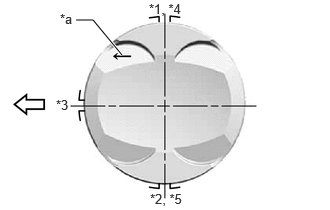
- Position the piston rings so that the ring ends are as shown in the illustration.
*1 No. 1 Compression Ring *2 No. 2 Compression Ring *3 Oil Ring Expander *4 Upper Side Rail *5 Lower Side Rail *a Front Mark 
Front of Engine
- Install the oil ring expander by hand.
- INSTALL CRANKSHAFT BEARING
- Clean the main journal and both surfaces of the crankshaft bearings and No. 2 crankshaft bearings.
- Type A:
HINT:
For type A, the same color is used for all of the crankshaft bearings.
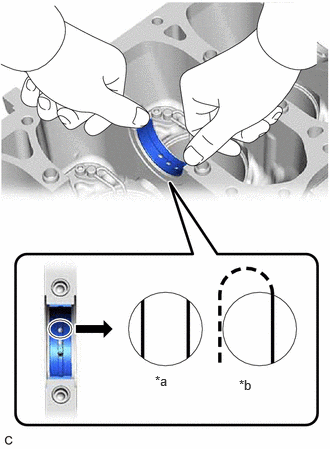
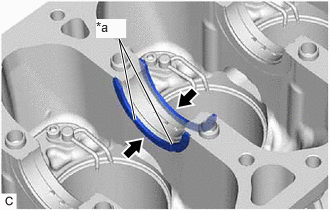
- Install the 5 crankshaft bearings to the cylinder block sub-assembly as shown in the illustration.
*a Correct *b Incorrect NOTE:Do not apply engine oil to the 5 crankshaft bearings or the contact surfaces.
HINT:
Both sides of the oil groove in the cylinder block sub-assembly should be visible through the oil feed holes in the crankshaft bearing. The amount visible on each side of the holes should be equal.
- Install the 5 crankshaft bearings to the cylinder block sub-assembly as shown in the illustration.
- Type B:
HINT:
For type B, a different color is used for each crankshaft bearing as listed in the below table.
CRANKSHAFT BEARING COLOR:Journal Position Crankshaft Bearing Color No. 1 Gray No. 2 Silver No. 3 Gray No. 4 Silver No. 5 Gray - Install the 5 crankshaft bearings to the cylinder block sub-assembly as shown in the illustration.
*a Correct *b Incorrect NOTE:Do not apply engine oil to the 5 crankshaft bearings or the contact surfaces.
HINT:
- Both sides of the oil groove in the cylinder block sub-assembly should be visible through the oil feed holes in the crankshaft bearing. The amount visible on each side of the holes should be equal.
- The color of the No. 1, No. 3 and No. 5 journal bearings are different from that of the No. 2 and No. 4 journal bearings. Be sure to check the color before installation.CRANKSHAFT BEARING COLOR:
Journal Position Crankshaft Bearing Color No. 1 Gray No. 2 Silver No. 3 Gray No. 4 Silver No. 5 Gray
- Install the 5 crankshaft bearings to the cylinder block sub-assembly as shown in the illustration.
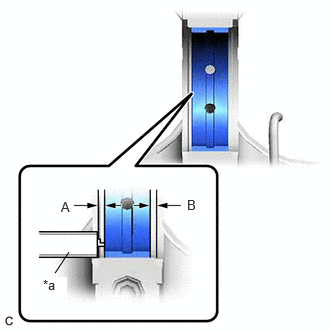
- Using a vernier caliper, measure the distance between the cylinder block sub-assembly edge and the crankshaft bearing edge.
Difference between (A) and (B)
0 to 0.7 mm (0 to 0.0276 in.)
*a Vernier Caliper - Type A:
HINT:
For type A, the same color is used for all of the No. 2 crankshaft bearings.
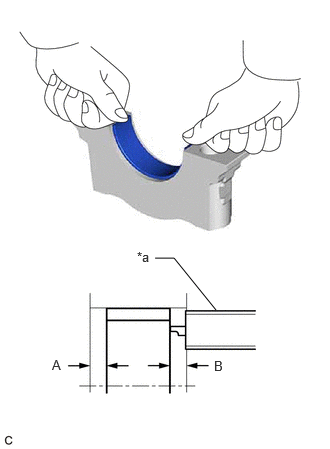
- Install the 5 No. 2 crankshaft bearings to the 5 crankshaft bearing caps.
*a Vernier Caliper - Using a vernier caliper, measure the distance between the crankshaft bearing cap edge and No. 2 crankshaft bearing edge.
Difference between (A) and (B)
0 to 0.9 mm (0 to 0.0354 in.)
NOTE:Do not apply engine oil to the No. 2 crankshaft bearings or the contact surfaces.
- Install the 5 No. 2 crankshaft bearings to the 5 crankshaft bearing caps.
- Type B:
HINT:
For type B, a different color is used for each No. 2 crankshaft bearing as listed in the below table.
CRANKSHAFT BEARING COLOR:Journal Position Crankshaft Bearing Color No. 1 Gray No. 2 Silver No. 3 Gray No. 4 Silver No. 5 Gray - Install the 5 No. 2 crankshaft bearings to the 5 crankshaft bearing caps.
*a Vernier Caliper HINT:
The color of the No. 1, No. 3 and No. 5 journal bearings are different from that of the No. 2 and No. 4 journal bearings. Be sure to check the color before installation.
CRANKSHAFT BEARING COLOR:Journal Position No. 2 Crankshaft Bearing Color No. 1 Gray No. 2 Silver No. 3 Gray No. 4 Silver No. 5 Gray - Using a vernier caliper, measure the distance between the crankshaft bearing cap edge and No. 2 crankshaft bearing edge.
Difference between (A) and (B)
0 to 0.9 mm (0 to 0.0354 in.)
NOTE:Do not apply engine oil to the No. 2 crankshaft bearings or the contact surfaces.
- Install the 5 No. 2 crankshaft bearings to the 5 crankshaft bearing caps.
- INSTALL CRANKSHAFT THRUST WASHER
- Apply engine oil to the crankshaft bearings, and place the crankshaft on the cylinder block sub-assembly.
- Apply engine oil to the crankshaft thrust washers.
- Install the 2 crankshaft thrust washers to the No. 3 journal position of the cylinder block sub-assembly with the oil grooves facing outward.
*a Oil Groove
- INSTALL CRANKSHAFT
- Apply engine oil to the No. 2 crankshaft bearings.
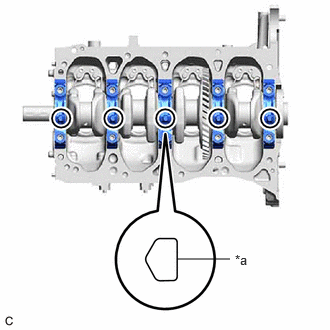
- Confirm the front marks and numbers, and install the 5 crankshaft bearing caps to the cylinder block sub-assembly with the front marks positioned as shown in the illustration.
*a Front Mark - Apply a light coat of engine oil to the threads and under the heads of the crankshaft bearing cap set bolts.
- Using a plastic hammer, lightly tap the crankshaft bearing caps to ensure a proper fit.
- Install the crankshaft bearing cap set bolts.NOTE:
The crankshaft bearing cap set bolts are tightened in 2 progressive steps.
- Step 1:
- Uniformly install and tighten the 10 crankshaft bearing cap set bolts in several steps in the order shown in the illustration.
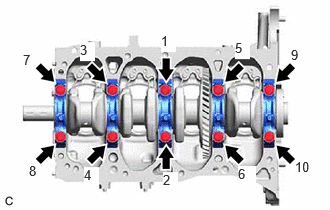 Courtesy of © TOYOTA, LICENSE AGREEMENT TMS1002
Torque: 61 N.m (622 kgf/cm, 45 ft.lbf)
HINT:
If a crankshaft bearing cap set bolt cannot be tightened to the specified torque, replace it.
- Uniformly install and tighten the 10 crankshaft bearing cap set bolts in several steps in the order shown in the illustration.
- Step 2:
- Check that the crankshaft turns smoothly.
- INSTALL CONNECTING ROD BEARING
HINT:
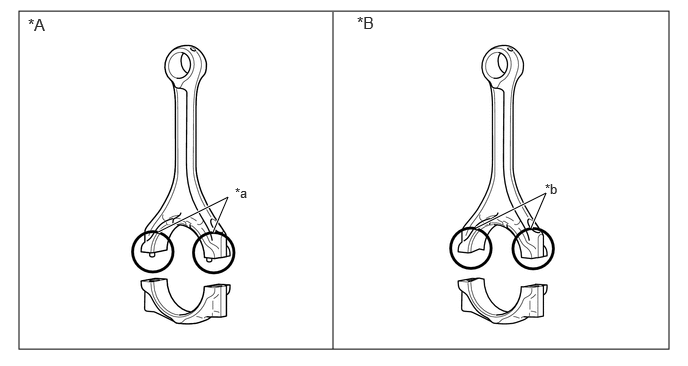
There are two types of connecting rod sub-assemblies; cracking connecting rods and other than cracking connecting rods.
*A except Cracking Connecting Rod *B Cracking Connecting Rod *a w/ Pin *b w/o Pin - Clean the connecting rod bearing contact surfaces of the connecting rod and connecting rod cap, and both surfaces of the 2 connecting rod bearings.
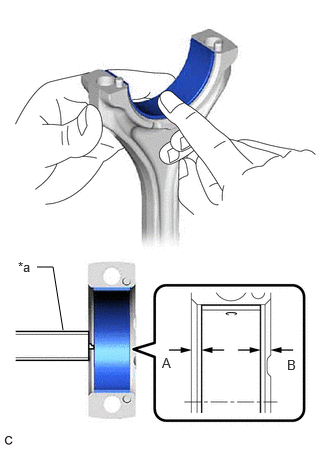
- Install the 8 connecting rod bearings to the 4 connecting rods and 4 connecting rod caps.
- except Cracking Connecting Rod:
- Using a vernier caliper, measure the distance between the edges of the connecting rod and connecting rod bearing.
*a Vernier Caliper Difference between (A) and (B)
0 to 0.7 mm (0 to 0.0276 in.)
NOTE:- Do not apply engine oil to the connecting rod bearing installation surface of the connecting rod and the connecting rod cap and to the back surface of the connecting rod bearing.
- Make sure to perform this measurement to determine if the connecting rod bearing is centered in the connecting rod.
- Using a vernier caliper, measure the distance between the edges of the connecting rod cap and connecting rod bearing.
Difference between (A) and (B)
0 to 0.7 mm (0 to 0.0276 in.)
NOTE:- Do not apply engine oil to the connecting rod bearing installation surface of the connecting rod and the connecting rod cap and to the back surface of the connecting rod bearing.
- Make sure to perform this measurement to determine if the connecting rod bearing is centered in the connecting rod cap.
- Using a vernier caliper, measure the distance between the edges of the connecting rod and connecting rod bearing.
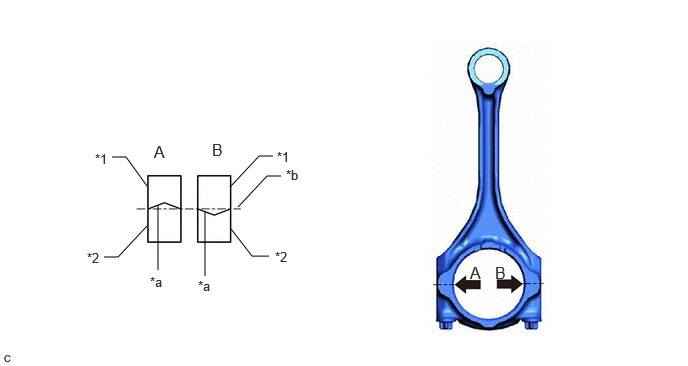
- Cracking Connecting Rod:NOTE:
Align the end surfaces of the connecting rod bearing with the V-shaped ends (center of the big end hole) to prevent burrs on the back of the connecting rod bearing from being created after fastening the connecting rod bolt.
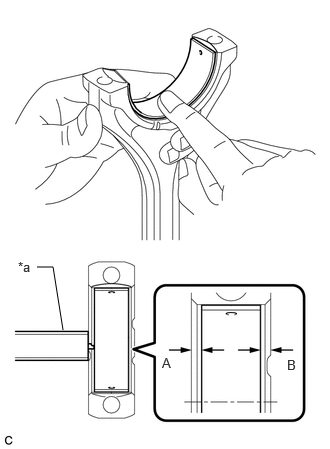
*1 Connecting Rod *2 Connecting Rod Cap *a Alignment surface *b Center of the big end hole - Using a vernier caliper, measure the distance between the edges of the connecting rod and connecting rod bearing.
Difference between (A) and (B)
0 to 0.7 mm (0 to 0.0276 in.)
*a Vernier Caliper NOTE:- Do not apply engine oil to the connecting rod bearing installation surface of the connecting rod and the connecting rod cap and to the back surface of the connecting rod bearing.
- Make sure to perform this measurement to determine if the connecting rod bearing is centered in the connecting rod.
- Using a vernier caliper, measure the distance between the edges of the connecting rod cap and connecting rod bearing.
Difference between (A) and (B)
0 to 0.7 mm (0 to 0.0276 in.)
NOTE:- Do not apply engine oil to the connecting rod bearing installation surface of the connecting rod and the connecting rod cap and to the back surface of the connecting rod bearing.
- Make sure to perform this measurement to determine if the connecting rod bearing is centered in the connecting rod cap.
- Using a vernier caliper, measure the distance between the edges of the connecting rod and connecting rod bearing.
- INSTALL PISTON WITH CONNECTING ROD
HINT:
There are two types of connecting rod sub-assemblies; cracking connecting rods and other than cracking connecting rods.
*A except Cracking Connecting Rod *B Cracking Connecting Rod *a w/ Pin *b w/o Pin - Apply engine oil to the cylinder walls, pistons, and surfaces of the connecting rod bearings.
- Position the piston rings so that the ring ends are as shown in the illustration.
*1 No. 1 Compression Ring *2 No. 2 Compression Ring *3 Oil Ring Expander *4 Upper Side Rail *5 Lower Side Rail *a Front Mark Front of Engine - Confirm that the ends of the oil ring expander are not overlapping and that the upper side rail and lower side rail are securely installed into the groove.
*a Press around the circumference *b Ring End *c Correct *d Incorrect (Ends of the oil ring expander are overlapping) NOTE:- After installing the oil ring expander, upper side rail and lower side rail, press around the circumference with a finger to check that they are securely installed into the groove.
- If the oil ring expander is not securely installed into the groove, check that the ends of the oil ring expander are not overlapping.
- If the ends of the oil ring expander are overlapping, remove the upper side rail and lower side rail and realign the oil ring expander using a screwdriver.
- except Cracking Connecting Rod:
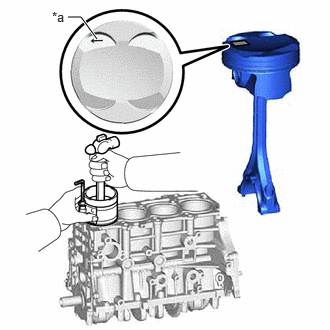
- Using a piston ring compressor, push the correctly numbered piston with connecting rod into the cylinder with the front marks of each piston with connecting rod facing the front of the engine.
*a Front Mark NOTE:- When inserting the piston with connecting rod into the cylinder block sub-assembly, make sure the connecting rod does not contact the No. 1 oil nozzle sub-assembly or No. 2 oil nozzle sub-assembly.
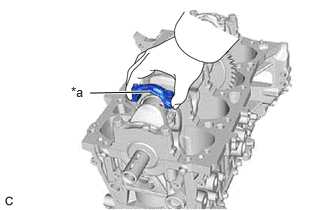
- Match each connecting rod cap to the correct connecting rod.
- Check that the front mark of the connecting rod cap is facing the correct direction, and install the connecting rod cap to the connecting rod.
*a Front Mark - Apply a light coat of engine oil to the threads and under the heads of the connecting rod bolts.
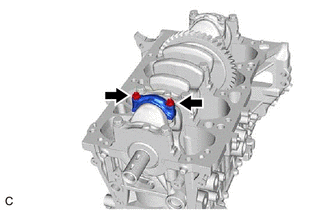
- Using an E12 "TORX" socket wrench, install and uniformly tighten the 8 connecting rod bolts.
Torque: 10 N.m (102 kgf/cm, 7 ft.lbf)
- Using an E12 "TORX" socket wrench, alternately tighten the 8 connecting rod bolts.
Torque: 38 N.m (387 kgf/cm, 28 ft.lbf)
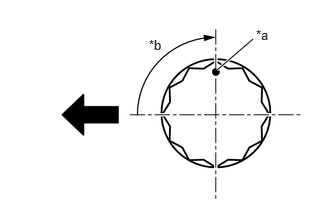
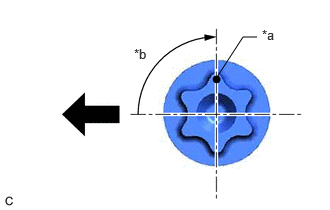
- Mark the front of the connecting rod bolts with paint.
*a Paint Mark *b 90° Front of Engine - Tighten the connecting rod bolts 90° as shown in the illustration.
- Check that the paint marks are now at a 90° angle to the front.
- Using a piston ring compressor, push the correctly numbered piston with connecting rod into the cylinder with the front marks of each piston with connecting rod facing the front of the engine.
- Cracking Connecting Rod:
- Using a piston ring compressor, push the correctly numbered piston with connecting rod into the cylinder with the front marks of each piston with connecting rod facing the front of the engine.
*a Front Mark NOTE:- When inserting the piston with connecting rod into the cylinder block sub-assembly, make sure the connecting rod does not contact the No. 1 oil nozzle sub-assembly or No. 2 oil nozzle sub-assembly.
- Match each connecting rod cap to the correct connecting rod.
- As foreign matter may occur from the fractured surface, make sure to remove all foreign matter before installing. Be careful not to damage the fractured surface.
- Check that the front mark of the connecting rod cap is facing the correct direction, and install the connecting rod cap to the connecting rod.
*a Front Mark - Apply a light coat of engine oil to the threads and under the heads of the connecting rod bolts.
- Using an E12 "TORX" socket wrench, install and uniformly tighten the 8 connecting rod bolts.
Torque: 10 N.m (102 kgf/cm, 7 ft.lbf)
NOTE:Do not use electric or air powered tools.
- Using an E12 "TORX" socket wrench, alternately tighten the 8 connecting rod bolts.
Torque: 38 N.m (387 kgf/cm, 28 ft.lbf)
- Mark the front of the connecting rod bolts with paint.
*a Paint Mark *b 90° Front of Engine - Tighten the connecting rod bolts 90° as shown in the illustration.
- Check that the paint marks are now at a 90° angle to the front.
- Using a piston ring compressor, push the correctly numbered piston with connecting rod into the cylinder with the front marks of each piston with connecting rod facing the front of the engine.
- Check that the crankshaft turns smoothly.
- Check the connecting rod thrust clearance.
See step 2 [12/2019 - 10/2022], or see step 2 [10/2022 - 11/2023], or see step 2 [11/2023 - ]
- INSTALL NO. 1 VENTILATION CASE