On-Vehicle Inspection [11/2023 - ]: Procedure
WARNING: This page is about a different variant/trim than selected.
- CHECK AUXILIARY BATTERY
- Check that the auxiliary battery cables are connected to the correct terminals.
If they are not, connect them properly.
- Check the auxiliary battery for damage and deformation. If severe damage, deformation or leakage is found, replace the auxiliary battery.
- Check the electrolyte level in each cell.
- For maintenance-free batteries:
- If the electrolyte level is below the lower line, replace the battery.
- For non-maintenance-free batteries:
- If the electrolyte level is below the lower line, add distilled water to each cell. Then, recharge the auxiliary battery and check the electrolyte specific gravity.
Standard Specific Gravity
1.25 or higher at 20°C (68°F)
- If the electrolyte level is below the lower line, add distilled water to each cell. Then, recharge the auxiliary battery and check the electrolyte specific gravity.
- For maintenance-free batteries:
- Check that the auxiliary battery cables are connected to the correct terminals.
- CHECK AUXILIARY BATTERY VOLTAGE
- Turn the ignition switch off and turn on the high beam headlights for 30 seconds. This will remove the surface charge from the auxiliary battery.
- Measure the auxiliary battery voltage according to the value(s) in the table below.
Result
Tester Connection Condition Specified Condition Result Positive (+) auxiliary battery terminal - Negative (-) auxiliary battery terminal 20°C (68°F)
Ignition switch off12.0 V or higher Auxiliary battery is OK 12.0 V or less Recharge auxiliary battery
- RECHARGE AUXILIARY BATTERY
- Recharge the auxiliary battery.
HINT:
- Recharge the auxiliary battery according to the charger's instructions.
- Apply the appropriate charging current according to the type of auxiliary battery shown in the table below.
Charge Method Charging Current Normal Below 5 A - Turn the ignition switch off and turn on the high beam headlights for 30 seconds. This will remove the surface charge from the auxiliary battery.
- Turn the headlights off.
- Measure the auxiliary battery voltage according to the value(s) in the table below.
Result
Tester Connection Condition Specified Condition Result Positive (+) auxiliary battery terminal - Negative (-) auxiliary battery terminal 20°C (68°F), ignition switch off 12.0 V or higher Auxiliary battery is OK 12.0 V or less Recharge auxiliary battery
- Recharge the auxiliary battery.
- CHECK AUXILIARY BATTERY TERMINAL, FUSIBLE LINK AND FUSE
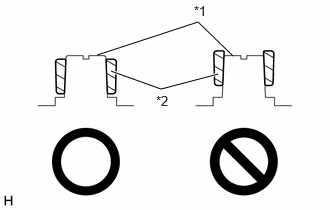
- Check that the auxiliary battery terminals are not loose or corroded.
If a terminal is loose or corroded, tighten or clean the terminal.
Standard
Battery Terminal Specified Condition Positive (+) terminal 5.4 N*m
55 kgf*cm
48 in.*lbfNegative (-) terminal 5.0 N*m
51 kgf*cm
44 in.*lbf - Measure the resistance of each fusible link and fuse for the auxiliary battery charging system.
Standard Resistance
Below 1 Ω
- Check that the auxiliary battery terminals are not loose or corroded.
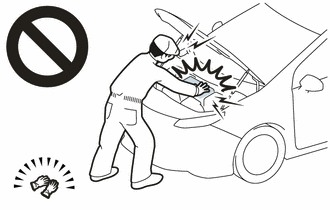
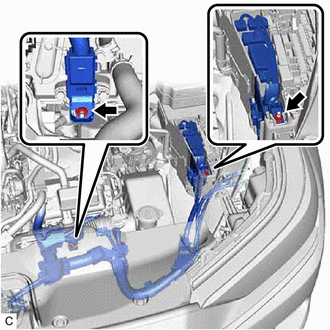
- CHECK AMD TERMINAL WARNING:
- Orange wire harnesses and connectors indicate high-voltage circuits. To prevent electric shock, always follow the procedure described in the repair information.
Refer to PRECAUTION [11/2023 - ]
- To prevent electric shock, wear insulated gloves when working on wire harnesses and components of the high voltage system.
- Remove the service plug grip.
- Check that the AMD terminal is connected securely, and there is no contact problem.
If there are any arc marks, replace the affected parts.
- Check that the nut for the AMD terminal is tightened to the specified torque.
Inverter with Converter Assembly Side
Torque: 10 N*m (102 kgf*cm, 7 ft.*lbf)
No. 1 Engine Room Relay Block and No. 1 Junction Block Assembly Side
Torque: 8.0 N*m (82 kgf*cm, 71 in.*lbf)
If there are no arc marks and the AMD terminal connection is faulty, connect the AMD terminal securely.
- Reinstall the service plug grip.
- Orange wire harnesses and connectors indicate high-voltage circuits. To prevent electric shock, always follow the procedure described in the repair information.
- CHECK DC/DC CONVERTER FUNCTION
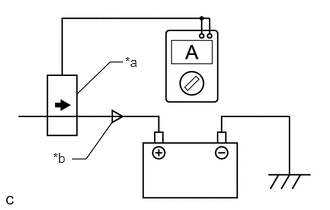
- Connect the AC/DC 400 A probe to the positive (+) auxiliary battery cable.
*a Probe Direction *b Current Flowing into Auxiliary Battery - Turn the ignition switch to ON (READY) and leave the vehicle as is until the electric current flowing to the auxiliary battery becomes 10 A or less.
- Turn on the high beam headlights, and turn the blower motor switch to the HI position and the rear window defogger on.
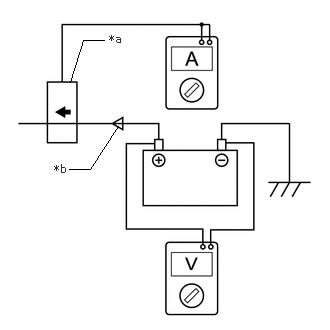
- Measure the current and voltage according to the value(s) in the table below.
*a Probe Direction *b Current Flowing from Auxiliary Battery Result
CURRENT FLOWING FROM AUXILIARY BATTERYTester Connection Condition Specified Condition Positive (+) auxiliary battery cable Ignition switch on (READY)
(The high beam headlights are on, the blower motor switch is in the HI position, and the rear window defogger is turned on.)0 A or less
(No current from auxiliary battery)AUXILIARY BATTERY VOLTAGETester Connection Condition Specified Condition Positive (+) auxiliary battery terminal - Negative (-) auxiliary battery terminal Ignition switch on (READY)
(The high beam headlights are on, the blower motor switch is in the HI position, and the rear window defogger is turned on.)12.5 to 15 V
- Connect the AC/DC 400 A probe to the positive (+) auxiliary battery cable.