Inspection [12/2019 - ]: Procedure
- INSPECT TIRES
- Inspect the tires for wear and proper inflation pressure.
Cold Tire Inflation Pressure
Tire Size Cold Tire Inflation Pressure Front Rear 235/65R18 106V
235/55R20 102V250 kPa (2.5 kgf/cm2 , 36 psi) 250 kPa (2.5 kgf/cm2 , 36 psi) Cold Tire Inflation Pressure (for Compact Spare Tire)
Tire Size Cold Tire Inflation Pressure T165/90D18 107M 420 kPa (4.2 kgf/cm2 , 60 psi) - Perform initialization.
For HV Model: Refer to INITIALIZATION [12/2019 - 11/2023] , or refer to INITIALIZATION [11/2023 - ]
For Gasoline Model: Refer to INITIALIZATION [12/2019 - 11/2023] , or refer to INITIALIZATION [11/2023 - ]
- Tire pressure adjustment method when warm:
- Adjust the tire pressure so that the displayed value is equal to the set pressure.
- Perform initialization and check that initialization completes.
For HV Model: Refer to INITIALIZATION [12/2019 - 11/2023] , or refer to INITIALIZATION [11/2023 - ]
For Gasoline Model: Refer to INITIALIZATION [12/2019 - 11/2023] , or refer to INITIALIZATION [11/2023 - ]
- Check and record the value of the Data List item "Temperature in Tire". (Ts)
- Check and record the ambient temperature during tire pressure adjustment. (Tm)
- Readjust the tire pressure according to the difference between the tire internal temperature (Ts) and the ambient temperature (Tm). (P)
HINT:
Tire internal temperature: Ts, Ambient temperature: Tm, Tire pressure readjustment value: P
P = (Specified Pressure) + (Ts - Tm)
- Check the pressure adjustment value with the Data List item "Tire Inflation Pressure".
Chassis > Tire Pressure Monitor > Data List
Tester Display ID 1 Tire Inflation Pressure ID 2 Tire Inflation Pressure ID 3 Tire Inflation Pressure ID 4 Tire Inflation Pressure ID 5 Tire Inflation Pressure ID 1 Temperature in Tire ID 2 Temperature in Tire ID 3 Temperature in Tire ID 4 Temperature in Tire ID 5 Temperature in Tire
- Perform initialization.
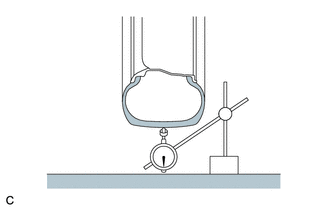
- Using a dial indicator, check the runout of the tires.
Maximum Tire Runout
1.4 mm (0.0551 in.)
HINT:
Measure the runout with the wheel assembly removed from the vehicle.
- Inspect the tires for wear and proper inflation pressure.
- ROTATE TIRES
- Remove the wheel assembly.
Refer to PROCEDURE - Step 1 [12/2019 - 10/2022] , or refer to PROCEDURE - Step 1 [10/2022 - ]
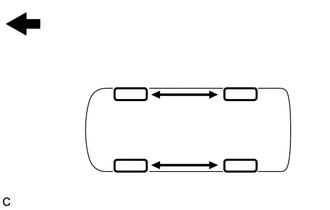
- Rotate the tires as shown in the illustration.

Front - Install the wheel assembly.
Refer to PROCEDURE - Step 1 [12/2019 - 10/2022] , or refer to PROCEDURE - Step 1 [10/2022 - ]
- Perform initialization.
For HV Model: Refer to INITIALIZATION [12/2019 - 11/2023] , or refer to INITIALIZATION [11/2023 - ]
For Gasoline Model: Refer to INITIALIZATION [12/2019 - 11/2023] , or refer to INITIALIZATION [11/2023 - ]
- Remove the wheel assembly.
- INSPECT AND ADJUST WHEEL BALANCE
- Inspect and adjust the off-the-car balance.
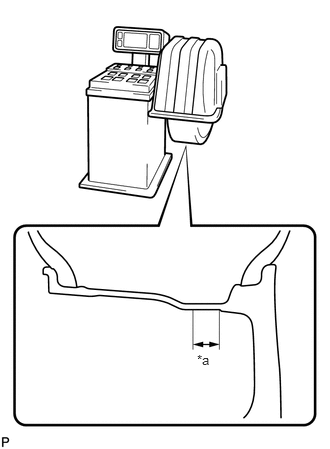
- For 20 Inch Wheel:
*a 25 mm (0.984 in.) Maximum Wheel Imbalance
8.0 g (0.0176 lb)
NOTE:- Use a cleaning detergent to remove dirt, oil and water from the surface where the balance weight is to be adhered.
- Do not touch the adhesive surface of the balance weight.
- Adhere a stick-on type balance weight to the flat surface*a shown in the illustration.
- Push the balance weight with your finger to securely adhere it to the desired position.
- Do not reuse balance weights.
- Use only TOYOTA genuine stick-on type balance weights or equivalent.
HINT:
- Use clip-on type balance weights for the inner side, and stick-on type balance weights for the outer side.
- If the tires vibrate even after the off-the-car balance adjustment, adjust the wheel balance with on-the-car balancing as necessary.
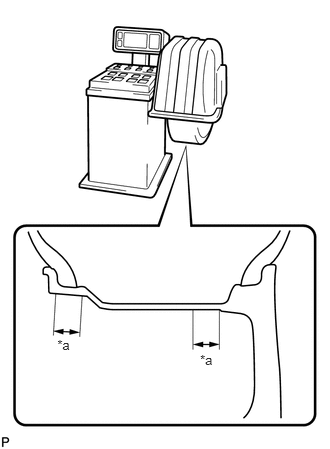
- For 18 Inch Wheel:
Maximum Wheel Imbalance
8.0 g (0.0176 lb)
NOTE:- Use a cleaning detergent to remove dirt, oil and water from the surface where the balance weight is to be adhered.
- Do not touch the adhesive surface of the balance weight.
- Adhere a stick-on type balance weight to the flat surface*a shown in the illustration.
- Push the balance weight with your finger to securely adhere it to the desired position.
- Do not reuse balance weights.
- Use only TOYOTA genuine stick-on type balance weights or equivalent.
HINT:
- Use stick-on type balance weights for both the inner and outer side.
- If the tires vibrate even after the off-the-car balance adjustment, adjust the wheel balance with on-the-car balancing as necessary.
*a 25 mm (0.984 in.)
- For 20 Inch Wheel:
- Inspect and adjust the off-the-car balance.
- INSPECT FRONT AXLE HUB BEARING
Refer to ON-VEHICLE INSPECTION [12/2019 - 10/2022] , or refer to ON-VEHICLE INSPECTION [10/2022 - 11/2023] , or refer to ON-VEHICLE INSPECTION [11/2023 - ]
- INSPECT REAR AXLE HUB BEARING
For 2WD: Refer to ON-VEHICLE INSPECTION [12/2019 - 10/2022] , or refer to ON-VEHICLE INSPECTION [10/2022 - 11/2023] , or refer to ON-VEHICLE INSPECTION [11/2023 - ]
For AWD: Refer to ON-VEHICLE INSPECTION [12/2019 - 10/2022] , or refer to ON-VEHICLE INSPECTION [10/2022 - 11/2023] , or refer to ON-VEHICLE INSPECTION [11/2023 - ]