Monitor Description
- Active Air fuel Ratio Control
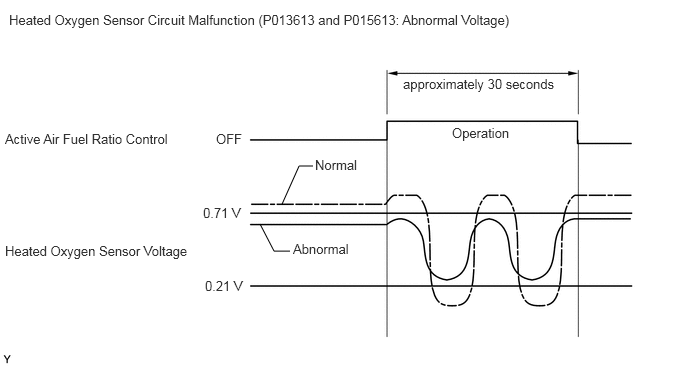
The ECM usually performs air fuel ratio feedback control so that the air fuel ratio sensor output indicates a near stoichiometric air fuel level. This vehicle includes active air fuel ratio control in addition to regular air fuel ratio control. The ECM performs active air fuel ratio control to detect any deterioration in the Three-Way Catalytic Converter (TWC) and heated oxygen sensor malfunctions (refer to the diagram below).
Active air fuel ratio control is performed for approximately 30 seconds while driving with a warm engine. During active air fuel ratio control, the air fuel ratio is forcibly regulated to become lean or rich by the ECM. If the ECM detects a malfunction, a DTC is stored.
- Abnormal Voltage Output of Heated Oxygen Sensor (DTCs P0136-13 and P0156-13)
While the ECM is performing active air fuel ratio control, the air fuel ratio is forcibly regulated to become rich or lean. If the sensor is not functioning properly, the voltage output variation is small. For example, when the heated oxygen sensor voltage does not increase to 0.71 V or higher during active air fuel ratio control, the ECM determines that the sensor voltage output is abnormal and stores DTC P0136-13 or P0156-13.
- Open in Heated Oxygen Sensor Circuit (DTCs P0136-17 and P0136-1C or P0156-17 and P0156-1C)
During active air fuel ratio control, the ECM calculates the Oxygen Storage Capacity (OSC)* of the Three-Way Catalytic Converter (TWC) by forcibly regulating the air fuel ratio to become rich or lean.
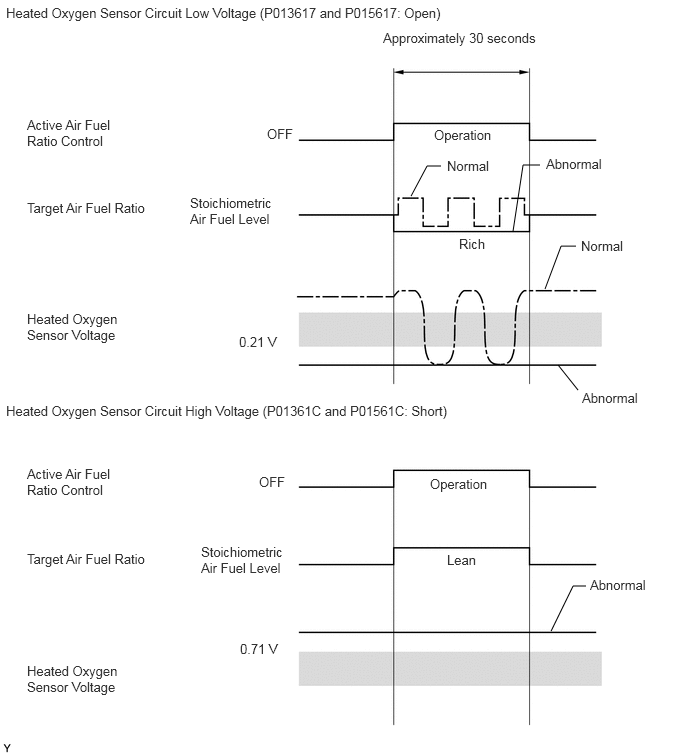
If the heated oxygen sensor has an open circuit, or the voltage output of the sensor noticeably decreases, the OSC indicates an extraordinarily high value. Even if the ECM attempts to continue regulating the air fuel ratio to become rich or lean, the heated oxygen sensor output does not change.
While performing active air fuel ratio control, when the target air fuel ratio is rich and the heated oxygen sensor voltage output is less than 0.21 V (lean), the ECM interprets this as an abnormally low sensor output voltage and stores DTC P0136-17 or P0156-17. When the target air fuel ratio is lean and the voltage output is higher than 0.71 V (rich) during active air fuel ratio control, the ECM determines that the sensor voltage output is abnormally high and stores DTC P0136-1C or P0156-1C.
HINT:
*: The TWC has the capability to store oxygen. The OSC and the emission purification capacity of the TWC are mutually related. The ECM determines whether the catalyst has deteriorated based on the calculated OSC value.
Refer to DTC P0420-00: Catalyst System Efficiency Below Threshold Bank 1; DTC P0430-00: Catalyst System Efficiency Below Threshold Bank 2 [12/2019 - 09/2020] , or refer to DTC P0420-00: Catalyst System Efficiency Below Threshold Bank 1; DTC P0430-00: Catalyst System Efficiency Below Threshold Bank 2 [09/2020 - 10/2022]
- High or Low Impedance of Heated Oxygen Sensor (DTCs P0136-11 and P0156-11 or P0136-14 and P0156-14)
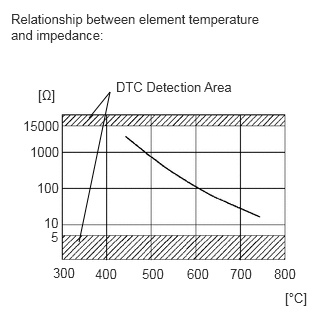
During normal air fuel ratio feedback control, there are small variations in the exhaust gas oxygen concentration. In order to continuously monitor the slight variation of the heated oxygen sensor signal while the engine is running, the impedance* of the sensor is measured by the ECM. The ECM determines that there is a malfunction in the sensor when the measured impedance deviates from the standard range.
*: The effective resistance in an alternating current electrical circuit.
HINT:
- The impedance cannot be measured using an ohmmeter.
- DTC P0136-11 or P0156-11 indicates the deterioration of the heated oxygen sensor. The ECM stores the DTC by calculating the impedance of the sensor when the typical enabling conditions are satisfied (2 driving cycles).
- DTC P0136-14 or P0156-14 indicates an open or short circuit in the heated oxygen sensor (2 driving cycles). The ECM stores the DTC when the impedance of the sensor exceeds the threshold 15 kΩ.
- Extremely High Output Voltage of Heated Oxygen Sensor (DTCs P0136-15 and P0156-15)
The ECM continuously monitors the heated oxygen sensor output voltage while the engine is running.
DTC P0136-15 or P0156-15 is stored if the heated oxygen sensor voltage output is 1.2 V or higher for 10 seconds or more.
- Abnormal Voltage Output of Heated Oxygen Sensor During Fuel-cut (DTCs P0136-23 and P0156-23)
The sensor output voltage drops to less than 0.2 V (extremely lean status) immediately when the vehicle decelerates and fuel cut is operating. If the voltage does not drop to less than 0.2 V for 7 seconds or more, the ECM determines that the sensor response has deteriorated, illuminates the MIL and stores a DTC.
- Abnormal Voltage Output of Heated Oxygen Sensor During Fuel-cut from Rich Condition (DTCs P013A-00 and P013C-00)
If the sensor output voltage does not drop from 0.35 to 0.2 V immediately when the vehicle decelerates and fuel cut is operating, the ECM illuminates the MIL and stores a DTC.