On-Vehicle Inspection [12/2019 - 10/2022]: Procedure
- INSPECT INTAKE SYSTEM WARNING:
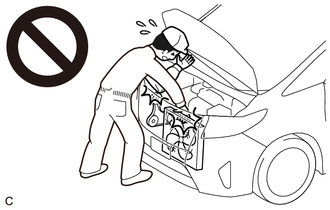
To prevent injury due to contact with an operating V-ribbed belt or cooling fan, keep your hands and clothing away from the V-ribbed belt and cooling fans when working in the engine compartment with the engine running or the ignition switch ON.
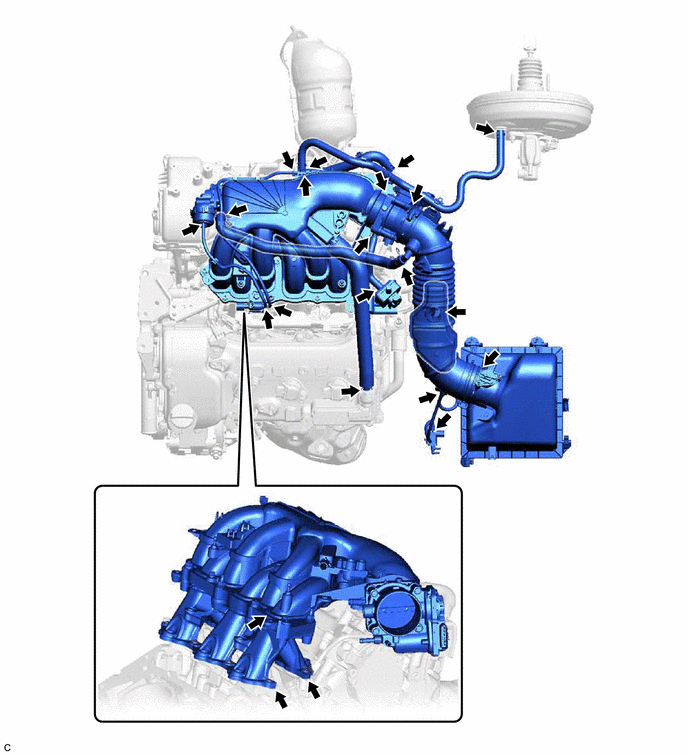
- Check that there are no vacuum leaks at the points shown in the illustration.
HINT:
Perform Inspection After Repair after repairing vacuum leaks in the intake system.
Refer to INITIALIZATION [12/2019 - 10/2022]
- Check that there are no vacuum leaks at the points shown in the illustration.
- INSPECT INTAKE AIR CONTROL VALVE (for ACIS)
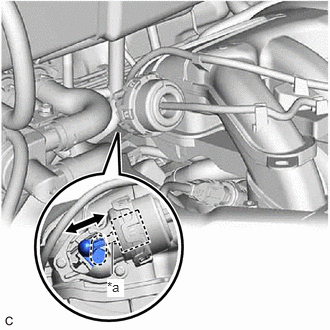
- When Activate the VSV for Intake Control is set to on, check that the actuator rod operates.
Powertrain > Engine > Active Test
Tester Display Activate the VSV for Intake Control If the actuator rod does not operate, inspect the intake air control valve (for ACIS) and No. 1 vacuum switching valve assembly (for ACIS).
- Inspect intake air control valve (for ACIS)
Refer to PROCEDURE - Step 1
- Inspect No. 1 vacuum switching valve assembly (for ACIS)
Refer to PROCEDURE - Step 1
*a Actuator Rod - Inspect intake air control valve (for ACIS)
- When Activate the VSV for Intake Control is set to off, check that the actuator rod returns to its original position.
If the actuator rod does not return to its original position, inspect the intake air control valve (for ACIS) and No. 1 vacuum switching valve assembly (for ACIS).
- Inspect intake air control valve (for ACIS)
Refer to PROCEDURE - Step 1
- Inspect No. 1 vacuum switching valve assembly (for ACIS)
Refer to PROCEDURE - Step 1
- Inspect intake air control valve (for ACIS)
- When Activate the VSV for Intake Control is set to on, check that the actuator rod operates.
- PERFORM INITIALIZATION
- Perform Inspection After Repair after repairing vacuum leaks in the intake system.
Refer to INITIALIZATION [12/2019 - 10/2022]
- Perform Inspection After Repair after repairing vacuum leaks in the intake system.