Caution / Notice / Hint
WARNING: This page is about a different variant/trim than selected.
WARNING:
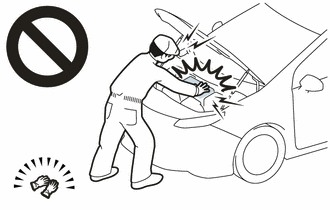
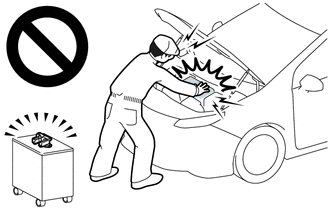
- Before the following operations are conducted, take precautions to prevent electric shock by turning the ignition switch off, wearing insulated gloves, and removing the service plug grip from HV battery.
- Inspecting the high-voltage system
- Disconnecting the low voltage connector of the inverter with converter assembly
- Disconnecting the low voltage connector of the HV battery
- Disconnecting the low voltage connector of the voltage inverter assembly (w/ 1500W voltage inverter)
- To prevent electric shock, make sure to remove the service plug grip to cut off the high voltage circuit before servicing the vehicle.
- After removing the service plug grip from the HV battery, put it in your pocket to prevent other technicians from accidentally reconnecting it while you are working on the high-voltage system.
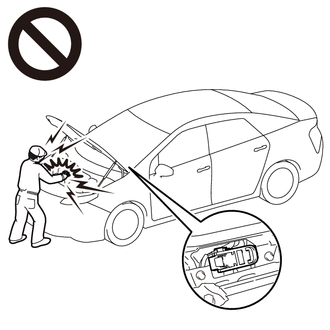
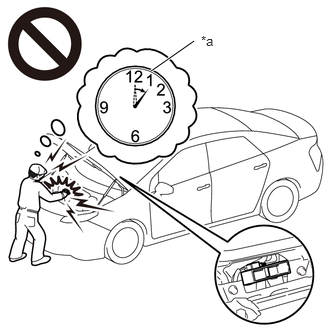
- After removing the service plug grip, wait for at least 10 minutes before touching any of the high-voltage connectors or terminals. After waiting for 10 minutes, check the voltage at the terminals in the inspection point in the inverter with converter assembly. The voltage should be 0 V before beginning work.
Refer to PRECAUTION [12/2019 - 10/2022]
HINT:
Waiting for at least 10 minutes is required to discharge the high-voltage capacitor inside the inverter with converter assembly.
*a Without waiting for 10 minutes
NOTE:
After turning the ignition switch off, waiting time may be required before disconnecting the cable from the negative (-) auxiliary battery terminal. Therefore, make sure to read the disconnecting the cable from the negative (-) auxiliary battery terminal notices before proceeding with work.
Refer to INITIALIZATION [12/2019 - 09/2020] , or refer to INITIALIZATION [09/2020 - 10/2021]
HINT:
- After repair, clear the DTCs, turn the ignition switch off and wait for 30 seconds or more and perform the following procedure to confirm that the auxiliary battery low voltage indicated by this DTC has been repaired.
- Wait for 2 minutes with the shift lever in P, the ignition switch ON (READY) and the following conditions met, then confirm that Data List item "BATT Voltage (Hybrid control system)" is between 13.0 and 15.0 V.
(If charging is not performed and the electrical load increases, +B voltage may not be steady and will gradually drop.)
- Headlight switch is in the HI position.
- A/C blower fan switch is in the HI position.
- Window defogger switch is turned on.
- Wait for 2 minutes with the shift lever in P, the ignition switch ON (READY) and the following conditions met, then confirm that Data List item "BATT Voltage (Hybrid control system)" is between 13.0 and 15.0 V.
- By performing the following procedure, the DC/DC converter function can be checked.
- Connect the AC/DC 400 A probe to the positive (+) auxiliary battery cable.
- Turn the ignition switch to ON (READY) and leave the vehicle as is until the electric current flowing to the auxiliary battery becomes 10 A or less.
- Turn the ignition switch to ON (READY) and turn the headlight switch and A/C blower fan switch to the HI position and the window defogger on.
- Confirm that the current drawn from the auxiliary battery is 0 A or lower and the auxiliary battery voltage is between 12.5 and 15.0 V.
- Connect the AC/DC 400 A probe to the positive (+) auxiliary battery cable.
- This DTC may be also stored when a part other than the DC/DC converter is malfunctioning or depending on user operation.
- If this vehicle is used to jump start another vehicle with a discharged battery, a fuse may blow due to overcurrent or the DC/DC converter self-protection may be activated. Also, if this vehicle is jump started by a vehicle with a 24 V battery, the same malfunction may occur and this DTC may be stored. (The suspended DC/DC converter control will return to normal by clearing the DTCs and turning the ignition switch off.)
- Check whether high electrical load equipment such as a high-capacitance audio device or electric kettle is used in the vehicle. (A fuse of the auxiliary battery may be blown due to overcurrent.)
- If the DC/DC converter is malfunctioning, the auxiliary battery cannot be charged. Therefore, once the ignition switch is turned off, it may be impossible to turn it to ON (READY) again if the auxiliary battery is completely discharged. In this case, charge the auxiliary battery. Be careful as charging is not performed during the inspection.
- If the ignition switch turns off immediately after it is turned to ON (READY), the auxiliary battery voltage may be low. Charge the auxiliary battery.