Charging [11/2023 - ]: Procedure
- INSPECT AUXILIARY BATTERY VOLTAGE
- Measure the auxiliary battery voltage.
Standard Voltage
Approximately 11 V or more
HINT:
- The horn should sound clearly.
- If the voltage is 10 V or less, either charge the auxiliary battery (charging usually takes about 1 hour), or replace it with an auxiliary battery that is already charged.
- Measure the auxiliary battery voltage.
- PREPARATION FOR HV BATTERY CHARGING WARNING:
- The hybrid system has high-voltage circuits. Accidents, such as electric shock, or electric leaks may result if the hybrid system is not operated in a correct manner. Make sure to follow the correct procedure.
- Be sure to wear insulated gloves.
HINT:
- Removing the service plug grip interrupts the high voltage circuit.
- High voltage wiring connectors are orange.
- Check the charge level of the HV battery.
- If the hybrid system fails to start and "Traction Battery Needs to be Protected Shift into P to Restart" is displayed on the multi-information display, the HV battery may be discharged.
- Confirm if the engine starts. If the engine starts, leave it idling with the shift lever in P until the engine stops (self charge has completed).
If the engine cannot start, charge the HV battery.
HINT:
- Before performing external charging, always use the GTS to perform troubleshooting.
- Charging time using a THS charger is 10 minutes per charge cycle. The charging time when using the THS charger is a short charging time (when the HV battery temperature is 25°C (77°F), 10 minutes may be sufficient, if the HV battery temperature is 0°C (32°F), then three 10 minute charge cycles may be required) for putting the engine in a condition where it can be started (the system can enter the READY-on state). (The THS charger will automatically stop 10 minutes after charging starts.)
- Remove the service plug grip.
Refer to REMOVAL [11/2023 - ]
- Check the terminal voltage.
- Remove the No. 2 inverter protector.
Refer to PROCEDURE - Step 9
- Disconnect the engine room main wire.
See step 4
- Remove the connector cover assembly.
Refer to PROCEDURE - Step 11
- Check the terminal voltage.
Refer to PROCEDURE - Step 12
- Install the connector cover assembly.
Refer to PROCEDURE - Step 7
- Connect the engine room main wire.
See step 31
- Install the No. 2 inverter protector.
Refer to PROCEDURE - Step 17
- Remove the No. 2 inverter protector.
- for 60/40 Split Seat Type:
- Remove the rear No. 1 seat assembly LH.
Refer to REMOVAL [12/2019 - ]
- Remove the rear No. 1 seat assembly RH.
Refer to REMOVAL [12/2019 - ]
- Remove the rear No. 1 seat assembly LH.
- for Captain Seat Type:
- Remove the rear No. 1 seat assembly.
Refer to REMOVAL [12/2019 - ]
- Remove the rear console box assembly.
Refer to REMOVAL [12/2019 - ]
- Remove the rear No. 1 seat assembly.
- Separate the front floor carpet assembly.
See step 5
- Remove the rear floor silencer.
See step 6
- Remove the No. 10 HV battery shield panel.
Refer to PROCEDURE - Step 20
- Disconnect the floor under wire.
Refer to PROCEDURE - Step 21
- Inspect the electrical insulation of the HV battery.
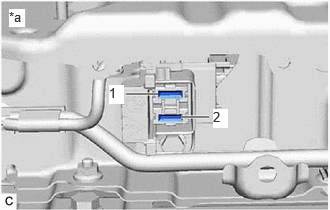
*a Service Plug Grip Removed
(Service Plug Grip Connecting Terminals)Using a megohmmeter set to 500 V, measure the resistance according to the value(s) in the table below.
NOTE:Be sure to set the megohmmeter to 500 V when performing this test. Using a setting higher than 500 V can result in damage to the component being inspected.
Standard Resistance
Tester Connection Condition Specified Condition 1 - Body ground Ignition switch off 10 MΩ or higher 2 - Body ground Ignition switch off 10 MΩ or higher - Using a megohmmeter set to 500 V, measure the resistance according to the value(s) in the table below.NOTE:
Be sure to set the megohmmeter to 500 V when performing this test. Using a setting higher than 500 V can result in damage to the component being inspected.
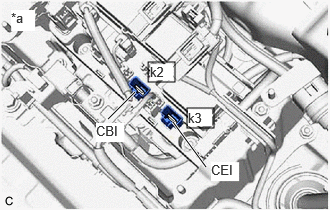
*a Component without harness connected
(HV Battery Junction Block Assembly)Standard Resistance
Tester Connection Condition Specified Condition k2-1 (CBI) - Body ground Ignition switch off 10 MΩ or higher k3-1 (CEI) - Body ground Ignition switch off 10 MΩ or higher
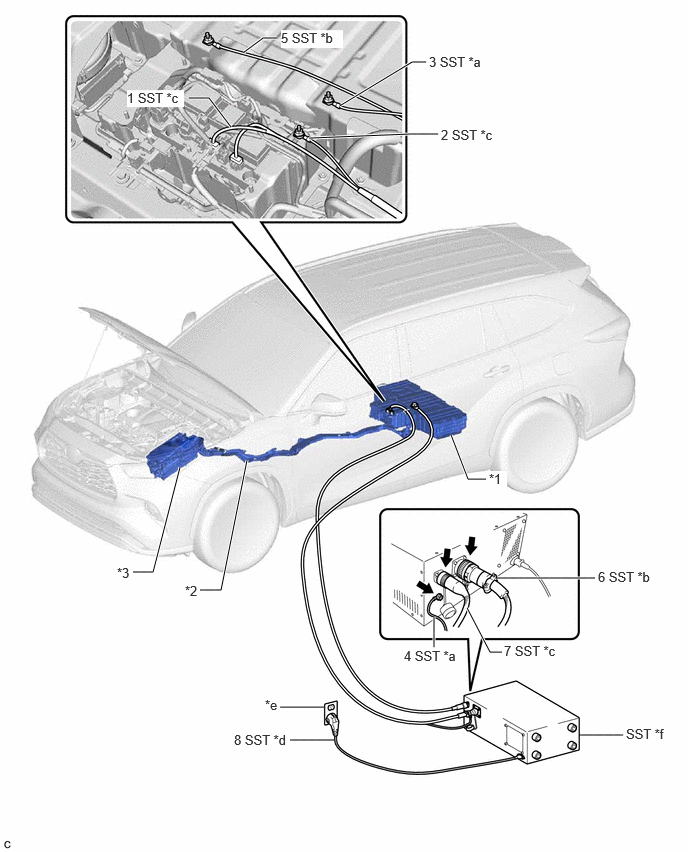
- Connect the THS charger in the order shown in the illustration.
*1 HV Battery *2 HV Floor Under Wire *3 Inverter with Converter Assembly - - *a EV Bonding Cable (Green Cable) *b Low Voltage Cable *c High Voltage Cable *d Power Input Plug *e Grounded AC 100 to 240 V Receptacle *f THS Charger NOTE:Connect all of the THS charger cables in the order shown in the illustration to prevent electrical shock.
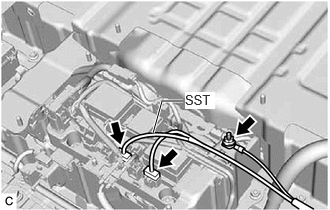
- Connect the 2 SST (high voltage cable) connectors to the HV battery junction block assembly.
- SST: 09882-10090
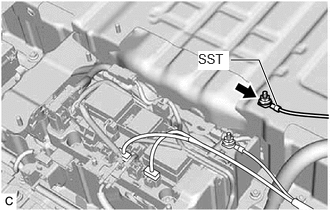
- Connect the SST (high voltage cable) terminal to the position shown in the illustration with the nut.
Torque: 7.5 N.m (76 kgf/cm, 66 in.lbf)
- Connect the SST (EV bonding cable (green cable)) terminal to the position shown in the illustration with the nut.
- SST: 09882-10070
Torque: 7.5 N.m (76 kgf/cm, 66 in.lbf)
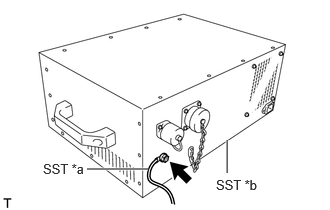
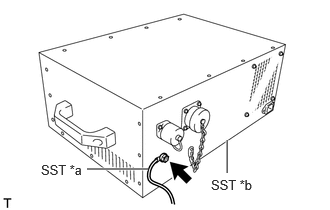
- Connect the SST (EV bonding cable (green cable)) terminal to SST (THS charger).
*a EV Bonding Cable (Green Cable) *b THS Charger - SST: 09880-10021
- 09881-10041
- SST: 09880-10021
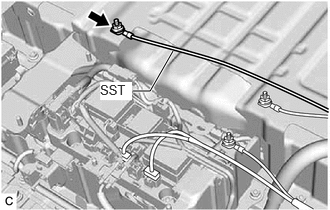
- Connect the SST (low voltage cable) terminal to the position shown in the illustration with the nut.
Torque: 7.5 N.m (76 kgf/cm, 66 in.lbf)
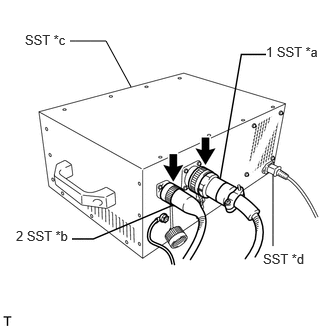
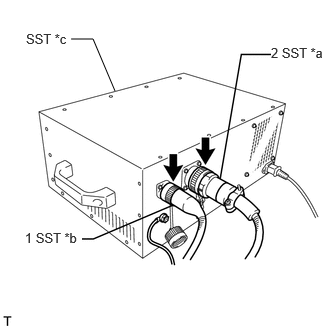
- Connect SST (low voltage cable) and SST (high voltage cable) to SST (THS charger) in the order shown in the illustration.
*a Low Voltage Cable *b High Voltage Cable *c THS Charger *d Power Input Plug - Install the service plug grip.
See step 1
- Connect the cable to the negative (-) auxiliary battery terminal.
Refer to PROCEDURE - Step 2
- Connect SST (power input plug) of SST (THS charger) to a grounded AC 100 to 240 V receptacle.
- SST: 09881-1008109881-1009009881-10050
NOTE:Always use an AC 100 to 240 V receptacle with a properly functioning ground. The ground is designed to reduce the chance of electric shock if a malfunction occurs. Do not use the charger if any of the pins on its plug have been damaged or removed.
- HV BATTERY CHARGING
- Check the value of the Data List item while performing the Active Test.
Powertrain > Hybrid Control > Active Test
Active Test Display Hybrid Battery Charge Data List Display SMRG Status SMRB Status HINT:
If the values of the Data List items are not as specified in the table below, turn the GTS and the ignition switch off and then perform the HV battery charging procedure again.
"System Main Relay Status - SMRB" and "System Main Relay Status - SMRG" in Data List during "Battery Charge" Active Test
Step Active Test
"Battery Charge"THS charger START
SwitchData List
"System Main Relay Status - SMRB"Data List
"System Main Relay Status - SMRG"1 OFF OFF OFF OFF 2 OFF → ON OFF OFF → ON OFF → ON 3 ON OFF → ON ON ON - Make sure that the EMERGENCY STOP switch is in the reset condition (the switch is turned clockwise and released).
- Make sure that the BREAKER is in the ON position.
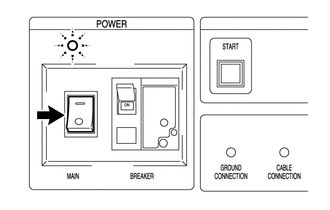
- Turn the THS charger MAIN switch on.
HINT:
The MAIN indicator will illuminate (green).
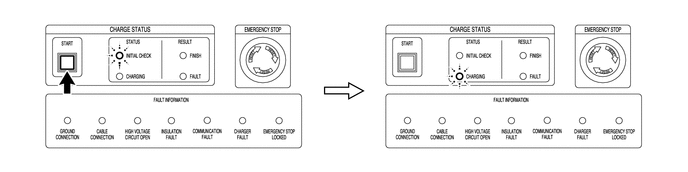
- Press the START switch.
HINT:
- When the START switch is turned on, the INITIAL CHECK indicator illuminates and an initial check starts. When the initial check completes successfully, the INITIAL CHECK indicator turns off, the CHARGING indicator illuminates and charging will start at the same time.
- While the INITIAL CHECK indicator is illuminated, the insulation, 400 V output, emergency stop switch, connector connections and ground connection are inspected.
- Repeat the charge cycle 3 times. When the last cycle has finished, turn the THS charger MAIN switch off.
HINT:
- Charging time using the THS charger is 10 minutes per charge cycle. The charging time when using a THS charger is a short charging time (when the battery temperature is 25°C (77°F), 10 minutes may be sufficient, if the battery temperature is 0°C (32°F), then three 10 minute charge cycles may be required) for putting the engine in a condition where it can be started (the system can enter the READY-on state). (The THS charger will automatically stop 10 minutes after charging starts.)
- There is very little chance of overcharging the HV battery during the second or third charging cycle. The SOC will not likely increase beyond the upper limit because it was low enough to prevent the engine from starting. Even if the SOC was to increase enough to exceed the limit, the hybrid vehicle control ECU will stop the Active Test to prevent overcharging.
- Cranking the engine once causes the SOC to drop approximately 1%.
- Charging the HV battery once (10 minutes) using the THS charger restores the SOC approximately 2%.
- Turn the ignition switch off.
- Remove the THS charger and connect the HV floor under wire (for HV Battery).
- Disconnect SST (power inlet plug) of SST (THS charger) from the grounded AC 100 to 240 V receptacle.
- Disconnect the cable from the negative (-) auxiliary battery terminal.
Refer to PROCEDURE - Step 3
- Remove the service plug grip.
See step 5
- Disconnect SST (high voltage cable) and SST (low voltage cable) from SST (THS charger) in the order shown in the illustration.
*a Low Voltage Cable *b High Voltage Cable *c THS Charger - Remove the nut and disconnect the SST (low voltage cable) terminal.
- Disconnect the SST (EV bonding cable (green cable)) terminal from SST (THS charger).
*a EV Bonding Cable (Green Cable) *b THS Charger - Remove the nut and disconnect the SST (EV bonding cable (green cable)) terminal.
- Remove the nut and disconnect the SST (high voltage cable) terminal.
- Disconnect the 2 SST (high voltage cable) connectors from the HV battery junction block assembly.
- Connect the floor under wire.
Refer to PROCEDURE - Step 10
- Install the No. 10 HV battery shield panel.
Refer to PROCEDURE - Step 11
- Install the service plug grip.
See step 1
- Connect the cable to the negative (-) auxiliary battery terminal.
Refer to PROCEDURE - Step 2
- Turn the ignition switch to ON (READY) and check if the engine starts.
HINT:
If the engine does not start, perform the HV battery charging operation again.
- Install the rear floor silencer.
See step 7
- Install the front floor carpet assembly.
See step 8
- for Captain Seat Type:
- Install the rear console box assembly.
Refer to INSTALLATION [12/2019 - ]
- Install the rear No. 1 seat assembly.
Refer to INSTALLATION [12/2019 - ]
- Install the rear console box assembly.
- for 60/40 Split Seat Type:
- Install the rear No. 1 seat assembly LH.
Refer to INSTALLATION [12/2019 - ]
- Install the rear No. 1 seat assembly RH.
Refer to INSTALLATION [12/2019 - ]
- Install the rear No. 1 seat assembly LH.
- Check the value of the Data List item while performing the Active Test.
- CHECK HV BATTERY AFTER HV BATTERY CHARGE
- Check for DTCs.
Refer to DTC CHECK / CLEAR [11/2023 - ]
- Perform the self-charging operation.
- Start the engine and leave it idling with the shift lever in P until the engine stops.
HINT:
When the engine stops idling, this indicates that self-charging is complete. Perform any initialization procedures required after the negative (-) auxiliary battery terminal is disconnected and reconnected.
- Start the engine and leave it idling with the shift lever in P until the engine stops.
- Check for DTCs.
- INITIALIZATION AFTER RECONNECTING AUXILIARY BATTERY TERMINAL
HINT:
When disconnecting and reconnecting the auxiliary battery, there is an automatic learning function that completes learning when the respective system is used.