Hydraulic Test [12/2019 - 10/2022]
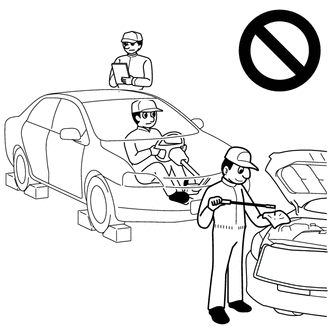
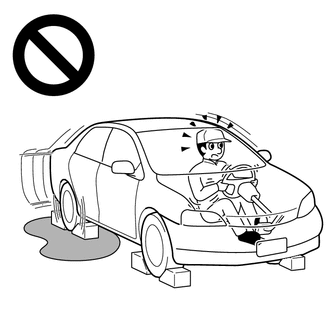
- PERFORM HYDRAULIC TEST WARNING:
- Do not perform a stall test if there are any people or objects near the vehicle.
- The vehicle could begin moving suddenly, resulting in a serious accident.
- Measure the line pressure.NOTE:
- Perform this test with the ATF (Automatic Transaxle Fluid) at the normal operating temperature: 50 to 80°C (122 to 176°F)
- Be careful to prevent the SST hose from contacting the exhaust pipe.
- This check must be conducted after checking and confirming that the engine is normal.
- Perform this test with the air conditioning off.
- Do not perform the stall test for longer than 5 seconds.
- When performing the stall speed test repeatedly, wait for 15 seconds or more between tests.
- The installation position of SST is different for the D position and R position line pressure tests.
- Perform this test with the AUTO function (shift-linked function) of the electronic parking brake system off.
- Check that there is no obstruction within 5 m (16.4 ft.) of the driving direction (forward of the vehicle when the shift lever in D, and behind the vehicle when the shift lever in R).
When torque is restricted by a safety function of the intelligent clearance sonar system, etc., the stall characteristics may not be normal.
- Warm up the ATF.
- Lift the vehicle.
- Remove the engine under cover.
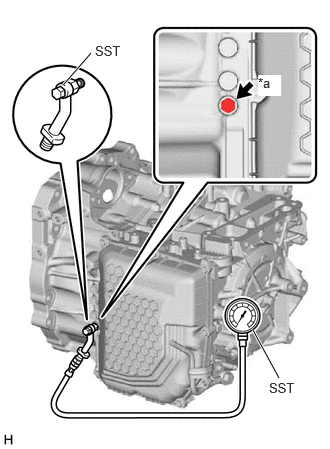
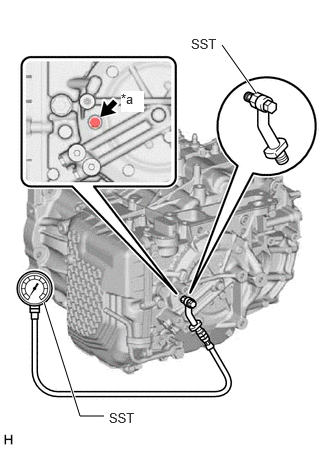
- Remove the test plug A on the front side of the transaxle case and install SST.
- SST: 09993-19015
- 09993-00010
- 09993-00040
*a Test Plug A - SST: 09993-19015
- Lower the vehicle.
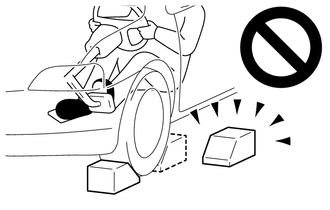
- Fully apply the parking brake and chock all 4 wheels.
HINT:
When the parking brake indicator (red) is illuminated after the electric parking brake switch (electric parking brake switch assembly) has been pulled to the lock side, the maximum amount of braking force is applied if the electric parking brake switch (electric parking brake switch assembly) is pulled to the lock side one more time.
- Start the engine and check the idle speed.
- Keep your left foot firmly on the brake pedal and move the shift lever to D.
- Measure the line pressure while the engine is idling.
Specified Line Pressure
Condition D Position Engine idling 500 to 700 kPa
(5.1 to 7.1 kgf/cm2 , 73 to 102 psi) - Depress the accelerator pedal as much as possible with your right foot. Quickly read the highest line pressure reading when the engine speed reaches stall speed.
Specified Line Pressure
Condition D Position Stall test 1300 to 1600 kPa
(13.3 to 16.3 kgf/cm2 , 189 to 232 psi) - Turn the ignition switch off.
- Remove SST and install the test plug A.
- Remove the test plug B on the left side of the transaxle case and install SST.
- SST: 09993-19015
- 09993-00010
- 09993-00040
*a Test Plug B - SST: 09993-19015
- Start the engine and check the idle speed.
- Keep your left foot firmly on the brake pedal and move the shift lever to R.
- Measure the line pressure while the engine is idling.
Specified Line Pressure
Condition R Position Engine idling 500 to 750 kPa
(5.1 to 7.6 kgf/cm2 , 73 to 109 psi) - Depress the accelerator pedal as much as possible with your right foot. Quickly read the highest line pressure reading when the engine speed reaches stall speed.
Specified Line Pressure
Condition R Position Stall test 1700 to 2100 kPa
(17.3 to 21.4 kgf/cm2 , 247 to 305 psi) - Turn the ignition switch off.
- Remove SST and install the test plug B.
- Clear the DTCs.
Powertrain > Transmission > Clear DTCs
EVALUATIONProblem Possible Cause Measured values at all positions are higher than specified - Solenoid (SLT) valve defective
- Regulator valve defective
Measured values at all positions are lower than specified - Solenoid (SLT) valve defective
- Regulator valve defective
- Oil pump defective
Pressure is low when shift lever is in D only - D position circuit fluid leak
- No. 1 clutch (C1) defective
- No. 2 brake (B2) defective
Pressure is low when shift lever is in R only - R position circuit fluid leak
- No. 3 clutch (C3) defective
- No. 2 brake (B2) defective
- Do not perform a stall test if there are any people or objects near the vehicle.