Adjustment [11/2023 - ]: Procedure
- BSM ECU DATA SAVE NOTE:
- Confirm that communication malfunction with other parts is not detected before changing blind spot monitor sensor.
- When the ECU data cannot be saved due to an ECU malfunction or a communication malfunction, perform the blind spot monitor beam axis confirmation.
- In the following situations, perform blind spot monitor beam axis confirmation after the blind spot monitor sensor has been replaced with a new one.
- When a minor collision is suspected.
- For a vehicle that has undergone sheet metal repairs.
- For a vehicle in which the system frequently operates inappropriately or fails to operate.
- When a DTC for rear side radar sensor (module "B") beam axis misalignment (horizontal) or rear side radar sensor (module "A") beam axis misalignment (horizontal) has been stored.
- When RoB code for rear side radar sensor (module "B") beam axis not adjusted or rear side radar sensor (module "A") beam axis not adjusted has been stored.
- When RoB code for rear side radar sensor (module "B") blockage or rear side radar sensor (module "A") blockage has been stored.
- When RoB code for rear side radar sensor (module "B") blockage Level 2 or rear side radar sensor (module "A") blockage Level 2 has been stored.
HINT:
By performing BSM "A" ECU data save or BSM "B" ECU data save, it becomes possible to save the beam axis adjustment value to the GTS.
- Connect the GTS to the DLC3.
- Turn the ignition switch to ON.
- Enter the following menus: Body Electrical / Blind Spot Monitor "A" or Blind Spot Monitor "B" / Utility.
HINT:
The "B" is on the LH side and the "A" is on the RH side.
Body Electrical > Blind Spot Monitor "B" > Utility
Tester Display BSM "B" ECU Data Save Body Electrical > Blind Spot Monitor "A" > Utility
Tester Display BSM "A" ECU Data Save - Check the results displayed for the BSM "A" ECU data save or BSM "B" ECU data save.
- BSM ECU DATA WRITE NOTE:
- The value saved from the old blind spot monitor sensor RH before replacement should be written to the new blind spot monitor sensor RH.
- The value saved from the old blind spot monitor sensor LH before replacement should be written to the new blind spot monitor sensor LH.
- In the following situations, to prevent incorrect or unnecessary operation of the blind spot monitor sensor, do not perform the procedure to write data to the BSM ECU.
- When the BSM data was copied from a different vehicle than the one to which BSM data will be written.
- When the BSM ECU data saved from the old blind spot monitor sensor LH before replacement will be written to a new blind spot monitor sensor RH.
- When the BSM ECU data saved from the old blind spot monitor sensor RH before replacement will be written to a new blind spot monitor sensor LH.
HINT:
By performing BSM "A" ECU data write or BSM "B" ECU data write, the beam axis adjustment value from the old blind spot monitor sensor before replacement can be written to the new blind spot monitor sensor.
- Connect the GTS to the DLC3.
- Turn the ignition switch to ON.
- Enter the following menus: Body Electrical / Blind Spot Monitor "A" or Blind Spot Monitor "B" / Utility.
HINT:
The "B" is on the LH side and the "A" is on the RH side.
Body Electrical > Blind Spot Monitor "B" > Utility
Tester Display BSM "B" ECU Data Write Body Electrical > Blind Spot Monitor "A" > Utility
Tester Display BSM "A" ECU Data Write - Check the results displayed for the BSM "A" ECU data write or BSM "B" ECU data write.
- PERFORM BLIND SPOT MONITOR BEAM AXIS CONFIRMATION
HINT:
The blind spot monitor beam axis confirmation is performed to confirm whether the sensor beam axis is correct, and to adjust the beam axis by using a reflector.
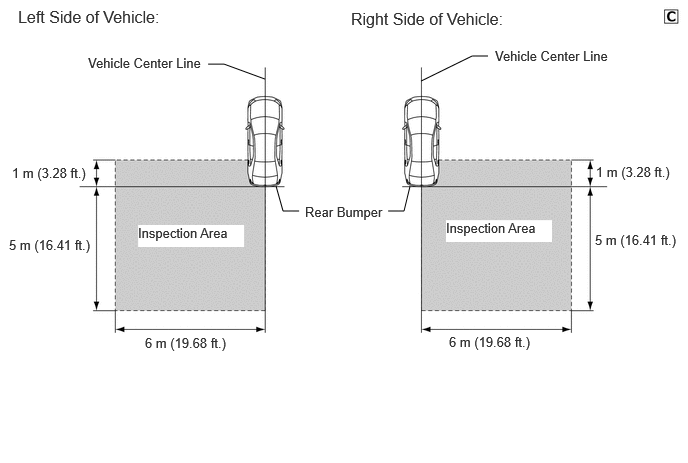
- When performing the blind spot monitor beam axis confirmation, move the vehicle to a place where the space shown in the illustration can be secured.NOTE:
- Perform this inspection on level ground.
- Make sure that there are no metal objects around the vehicle or on the ground.
- Unload the vehicle before beginning the inspection.
- Confirm that the tire pressure is correct before beginning the inspection.
- Do not place any objects other than the reflector (such as a large metallic object) in the inspection area or allow people to enter the inspection area (W 6 m [19.68 ft.] x L 6 m [19.68 ft.] x H 4 m [13.12 ft.]) shown in the illustration.
- Place the reflector.
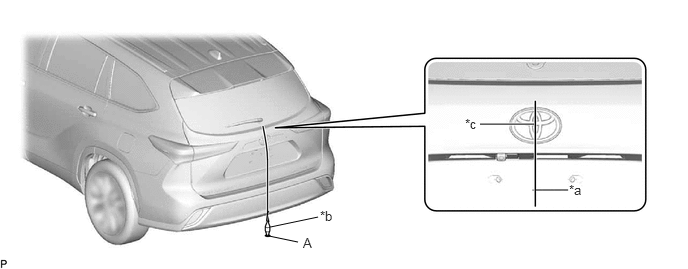
- Hang a weight with a pointed tip from the center of the rear emblem, and mark the rear center point of the vehicle (point A) on the ground.
*a String *b Weight *c Center - - HINT:
Lightly flick the string with your fingers several times to confirm that the string is aligned with mark A.
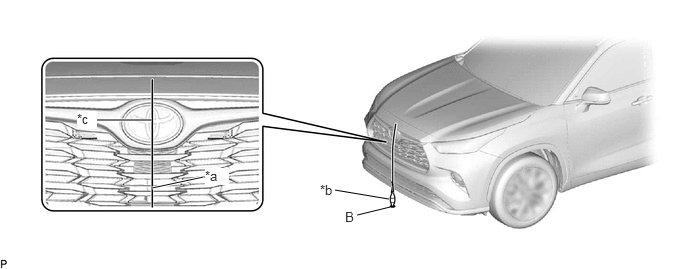
- Hang a weight with a pointed tip from the center of the radiator grille (or front panel) emblem, and mark the front center point of the vehicle (point B) on the ground.
*a String *b Weight *c Center - - HINT:
Lightly flick the string with your fingers several times to confirm that the string is aligned with mark B.
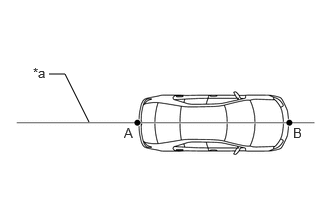
- Draw a vehicle center line so that it passes through mark A and B (front and rear center points).
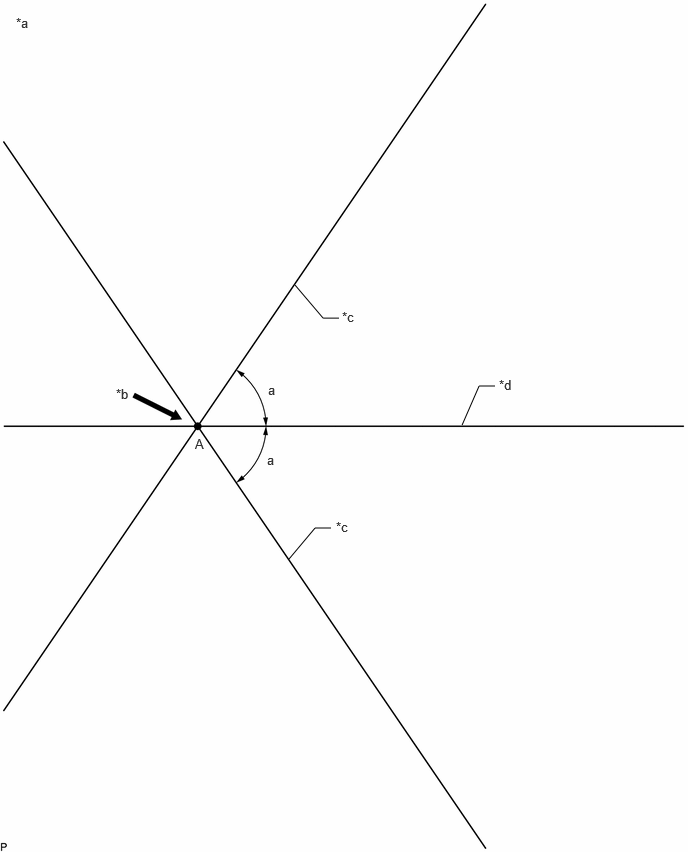
*a Vehicle Center Line - Enlarge and print out the poster shown in the illustration.
*a Poster *b Edge of Rear Bumper *c Line C *d Vehicle Center Line Standard
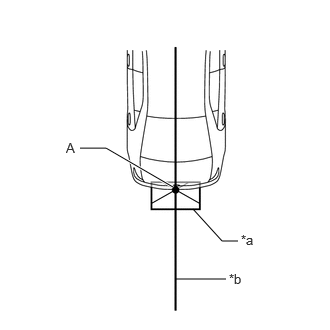
Part Angle a 55.7° - Attach the printed poster to the floor with the vehicle center line aligned with point A as shown in the illustration.
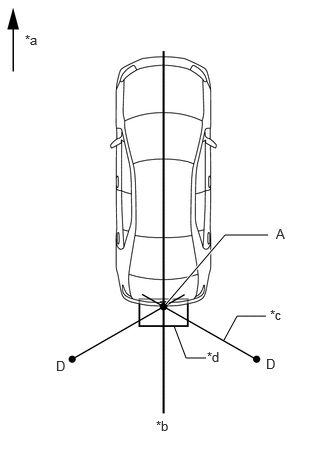
*a Poster *b Vehicle Center Line - Align a piece of string with line C and mark point D at a distance of 2935 mm (9.63 ft.) from point A.
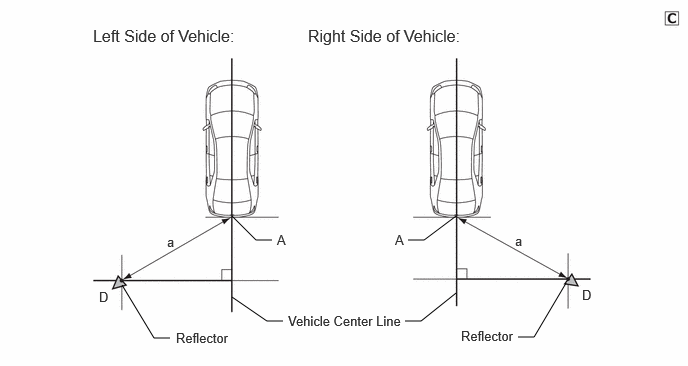
*a Vehicle Front *b Vehicle Center Line *c String *d Poster - Set the reflector at the point D shown in the illustration below.
- SST: 09870-60000
- 09870-60010
- SST: 09870-60040
Standard
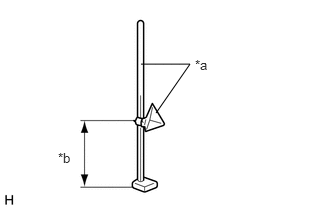
Part Length a 2935 mm (9.63 ft.) NOTE:- Set the reflector so that its center is 752 mm (2.47 ft.) above the ground.
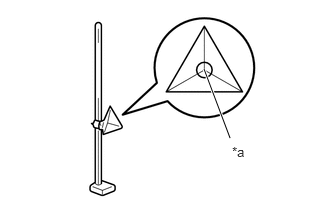
*a SST (reflector) *b 752 mm (2.47 ft.) - The center of the triangular pyramid is the reference point for the setting position and angle.
*a Center of Triangular Pyramid - Set the reflector as shown in the illustration so that the center of the triangular pyramid faces the blind spot monitor sensor.
- SST: 09870-60000
- Hang a weight with a pointed tip from the center of the rear emblem, and mark the rear center point of the vehicle (point A) on the ground.
- Perform the blind spot monitor beam axis display.
- Connect the GTS to the DLC3.
- Turn the ignition switch to ON.
- Turn the blind spot monitor system on.
- Turn the GTS on.
- Enter the following menus: Body Electrical / Blind Spot Monitor "B" or Blind Spot Monitor "A" / Utility / BSM "B" Beam Axis Display or BSM "A" Beam Axis Display.
HINT:
The "B" is on the LH side and the "A" is on the RH side.
Body Electrical > Blind Spot Monitor "B" > Utility
Tester Display BSM "B" Beam Axis Display Body Electrical > Blind Spot Monitor "A" > Utility
Tester Display BSM "A" Beam Axis Display - Check the results displayed for the BSM beam axis display.
Allowable Range
Item Blind Spot Monitor Sensor LH Blind Spot Monitor Sensor RH Angle -3.6 to +3.6° -3.6 to +3.6° HINT:
If the displayed results are outside the permissible range, the following are possible causes. Therefore, implement countermeasures, check the blind spot monitor beam axis and perform the procedure again.
Possible Causes Countermeasure Incorrect SST (reflector) position Check the position of SST (reflector) and checking space and perform the procedure again A metallic object is located in the vicinity of the checking space Check the position of SST (reflector) and checking space and perform the procedure again The blind spot monitor sensor installation is abnormal Check the installation condition of the blind spot monitor sensor
- Perform the blind spot monitor beam axis adjustment.
- Enter the following menus: Body Electrical / Blind Spot Monitor "B" or Blind Spot Monitor "A" / Utility / BSM "B" Beam Axis Adjustment or BSM "A" Beam Axis Adjustment.
Body Electrical > Blind Spot Monitor "B" > Utility
Tester Display BSM "B" Beam Axis Adjustment Body Electrical > Blind Spot Monitor "A" > Utility
Tester Display BSM "A" Beam Axis Adjustment HINT:
When values on the axis display are in the allowable range, performing this adjustment compensates for any deviation from the normal value.
- Enter the following menus: Body Electrical / Blind Spot Monitor "B" or Blind Spot Monitor "A" / Utility / BSM "B" Beam Axis Adjustment or BSM "A" Beam Axis Adjustment.
- When performing the blind spot monitor beam axis confirmation, move the vehicle to a place where the space shown in the illustration can be secured.
- PERFORM BLIND SPOT MONITOR SENSOR INSTALLATION CONDITION INSPECTION NOTE:
- Perform this inspection on level ground.
- Unload the vehicle before beginning the inspection.
- Confirm that the tire pressure is correct before beginning the inspection.
HINT:
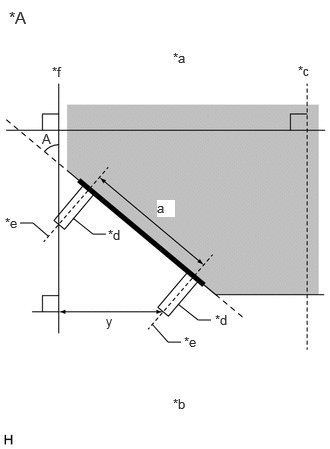
The blind spot monitor sensor installation condition inspection is performed to confirm whether the sensor is perpendicular to the floor surface (+/-2.2°) by using a digital angle gauge, and that the sensor is 46 to 54° from the line parallel to the vehicle center line.
- Remove the rear bumper assembly.
Refer to REMOVAL [11/2023 - ]
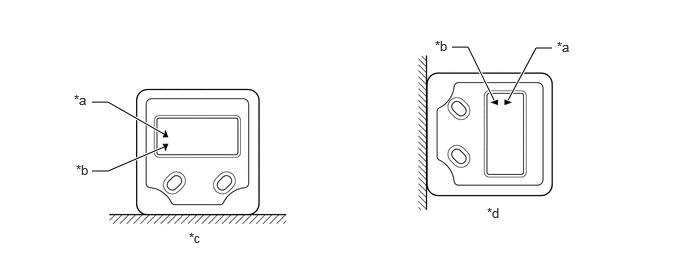
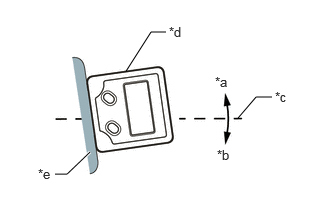
- Place the digital angle gauge on a level (gradient within 1%) and perform zero-point adjustment as shown in the illustration.
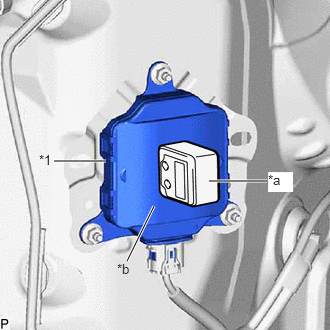
*a (+) *b (-) *c When Storing Zero Point *d After Storing Zero Point, Indicates 90° When Fully Horizontal - Set the digital angle gauge to the outward facing surface of the blind spot monitor sensor as shown in the illustration, and check that the perpendicular angle of the blind spot monitor sensor is within the permissible range.
*1 Blind Spot Monitor Sensor *a Digital Angle Gauge *b Outward Facing Surface NOTE:The sensor angle is the measured sensor angle subtracted from 90°.
*a (+) *b (-) *c Horizontal Line *d Digital Angle Gauge *e Outward Facing Surface HINT:
- The digital angle gauge should indicate 90° when turned on its side.
- The outward facing surface (installation angle) is positive (+) when it faces higher than horizontal.
Standard
Item Allowable Range Blind Spot Monitor Sensor LH +2.2 to -2.2° Blind Spot Monitor Sensor RH +2.2 to -2.2° - Using the sensor installation stud bolt center lines as a reference, check that the stud bolts are as shown in the illustration.
Standard
Dimension Specified Value a 108 mm (4.25 in.) y 78 to 87 mm
(3.07 to 3.43 in.)Degree Specified Value A 46 to 54° *A Vehicle Rear (LH) *a Vehicle Front *b Vehicle Rear *c Vehicle Center Line *d Stud Bolt *e Stud Bolt Center Line *f Line Parallel to Vehicle Center Line HINT:
If the results are not as specified, it is possible that the blind spot monitor sensor installation area (frame, stud bolt) is deformed, so make corrections as necessary.