General Information [12/2019 - ]
- GENERAL DESCRIPTION
- This information is written in accordance with SAE J2008.
- Repair operations can be separated mainly into the following 3 processes:
- Diagnosis
- Removing/Installing, Replacing, Disassembling/Reassembling, Checking and Adjusting
- Final Inspection
- The following procedures are omitted from this information. However, these procedures must be performed.
- Use a jack or lift to perform operations.
- Clean all removed parts.
- Perform a visual check before and after performing any work.
- PREPARATION
- Use of Special Service Tools (SST) and Special Service Materials (SSM) may be required, depending on the repair procedure. Be sure to use SST and SSM when they are required and follow the work procedure properly. A list of SST and SSM is in the "Preparation" information.
- REPAIR PROCEDURES
- A component illustration is placed under the title where necessary.
- Non-reusable parts, grease application areas, precoated parts and torque specifications are noted in the component illustrations.
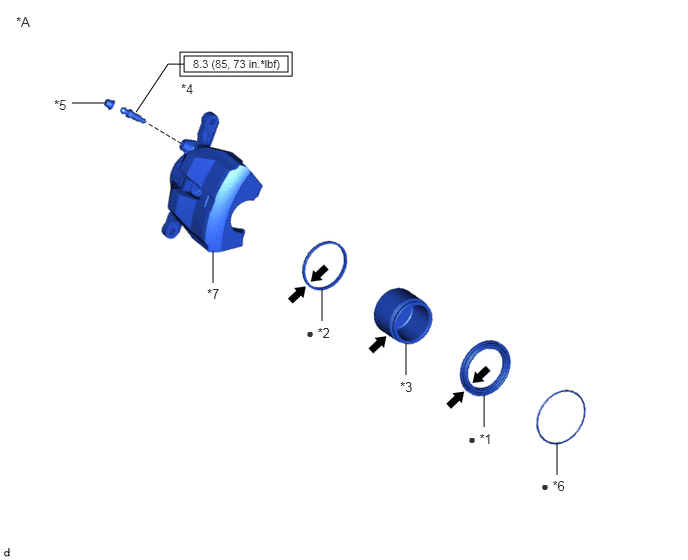
- The following illustration is an example.
Symbol Contents 
Tightening torque for "Major areas involving basic vehicle performance such as moving/turning/stopping": N*m (kgf*cm, ft.*lbf) 
N*m (kgf*cm, ft.*lbf): Specified torque • Non-reusable part * Precoated part 
Apply Lubricant Here 
Do not apply lubricants to the threaded parts WARNING:"Major areas involving basic vehicle performance such as moving/turning/stopping" indicates areas that require a higher degree of precision when tightening.
*A Example - - *1 CYLINDER BOOT *2 PISTON SEAL *3 FRONT DISC BRAKE PISTON *4 FRONT DISC BRAKE BLEEDER PLUG *5 FRONT DISC BRAKE BLEEDER PLUG CAP *6 SET RING *7 DISC BRAKE CYLINDER ASSEMBLY LH - - Tightening torque for "Major areas involving basic vehicle performance such as moving/turning/stopping": N*m (kgf*cm, ft.*lbf) N*m (kgf*cm, ft.*lbf): Specified torque • Non-reusable part Lithium soap base glycol grease - Torque specifications, grease application areas and non-reusable parts are emphasized in the procedures.
HINT:
There are cases where such information can only be explained by using an illustration. In these cases, torque, oil and other information are described in the illustration.
- Only items with key points are described in the text. What to do and other details are explained using illustrations next to the text. Both the text and illustrations are accompanied by standard values and notices.
Illustration What to do and where to do it Task heading What work will be performed Explanation text - How to perform the task
- Information such as specifications and warnings, which are written in boldface text
- Illustrations of similar vehicle models are sometimes used. In these cases, minor details may be different from the actual vehicle.
- Procedures are presented in a step-by-step format.
- SERVICE SPECIFICATIONS
- Specifications are presented in boldface text throughout the information. The specifications are also found in the "Specifications" information for reference.
- TERM DEFINITIONS
CAUTION Possibility of injury to you or other people NOTICE Possibility of damage to components being repaired HINT Provides additional information to help you perform repairs - INTERNATIONAL SYSTEM OF UNITS
- The units used in this information comply with the International System of Units (SI UNIT) standard. Other units from the metric system and the English system are also provided.
- Example:
Torque: 30 N*m (306 kgf*cm, 22 ft.*lbf)
- The units used in this information comply with the International System of Units (SI UNIT) standard. Other units from the metric system and the English system are also provided.