On-Vehicle Inspection [12/2019 - 09/2020]: Procedure
- CHECK RADIATOR CAP SUB-ASSEMBLY WARNING:
Do not remove the radiator cap sub-assembly while the engine and radiator assembly are still hot. Pressurized, hot engine coolant and steam may be released and cause serious burns.
- Measure the valve opening pressure.
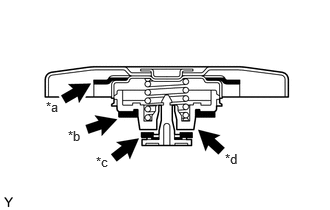
*a Rubber Packing (1) *b Rubber Packing (2) *c Rubber Packing (3) *d Valve Seat - If there are water stains or foreign matter on the rubber packing (1), (2) or (3), clean the part(s) with water and finger scouring.
- Check that the rubber packings (1), (2) and (3) are not deformed, cracked or swollen.
- Check that the rubber packing (3) and valve seat are not stuck together.
- Apply engine coolant to the rubber packings (2) and (3) before using a radiator cap tester.
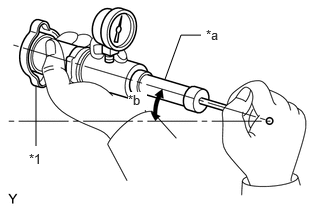
- When using the radiator cap tester, tilt it upward 30° or more.
*1 Radiator Cap Sub-assembly *a Radiator Cap Tester *b 30° or more - Pump the radiator cap tester several times, and check the maximum pressure.
Pumping Speed
1 pump per second
Result
Item Specified Condition Standard pressure
(for brand-new radiator cap sub-assembly)74 to 103 kPa (0.8 to 1.1 kgf/cm2 , 10.7 to 14.9 psi) Minimum pressure
(for used radiator cap sub-assembly)59 kPa (0.6 kgf/cm2 , 8.6 psi) HINT:
Even if the radiator cap sub-assembly cannot maintain the maximum pressure, it is not a defect.
If the maximum pressure is less than the minimum pressure, replace the radiator cap sub-assembly.
- Measure the valve opening pressure.
- CHECK RADIATOR ASSEMBLY FOR CLOGGING WARNING:
To prevent burns, do not touch the engine or other high temperature components while the engine is hot.
- Remove the cool air intake duct seal.
Refer to PROCEDURE - Step 1
- Remove the inlet air cleaner assembly.
Refer to PROCEDURE - Step 6
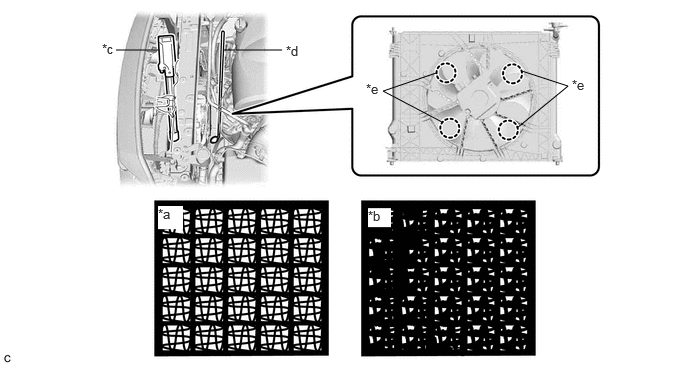
- Shine an electric light at the radiator assembly from the front and check the radiator assembly for clogging using a mirror.
*a OK *b NG *c Electric Light *d Mirror *e Areas to be checked - - OK
The radiator assembly is not clogged.
If the radiator assembly is clogged, clean it.
- Install the inlet air cleaner assembly.
Refer to PROCEDURE - Step 20
- Install the cool air intake duct seal.
Refer to PROCEDURE - Step 4
- Remove the cool air intake duct seal.
- CLEAN RADIATOR ASSEMBLY WARNING:
To prevent burns, do not touch the engine or other high temperature components while the engine is hot.
- Remove the No. 2 radiator air guide.
See step 16
- Cover the opening of each air duct with a piece of cloth.
- Clean the cooler condenser assembly.
- Check that the washer nozzle is not clogged.
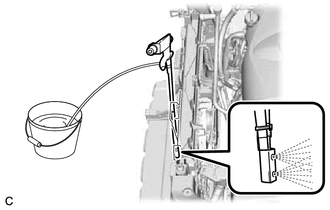
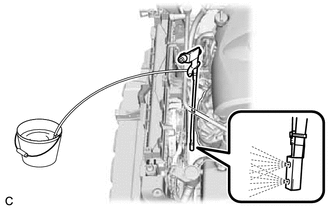
- Insert the washer nozzle into the space in front and spray it.NOTE:
- Clean the fins of the cooler condenser assembly by spraying the entire area for 150 seconds. Repeat this process twice.
- Set the air pressure to 0.4 MPa (4.1 kgf/cm2 , 58 psi).
- Check that water sprays in mist form from the nozzle.
- Keep the nozzle parallel to the cooler condenser assembly.
- Do not allow the nozzle to contact the fins of the cooler condenser assembly.
- Keep the nozzle moving while spraying water.
- Do not spray the cooler compressor assembly or generator assembly excessively.
- Leave the cooler condenser assembly as is for 10 minutes to let the water penetrate the dirt.
- Clean the cooler condenser assembly again.NOTE:
- Clean the fins of the cooler condenser assembly by spraying the entire area for 150 seconds. Repeat this process 4 times.
- Set the air pressure to 0.4 MPa (4.1 kgf/cm2 , 58 psi).
- Check that water sprays in mist form from the nozzle.
- Keep the nozzle parallel to the cooler condenser assembly.
- Do not allow the nozzle to contact the fins of the cooler condenser assembly.
- Keep the nozzle moving while spraying water.
- Do not spray the cooler compressor assembly or generator assembly excessively.
- Using an air blow gun, dry the cooler condenser assembly for 3 minutes.
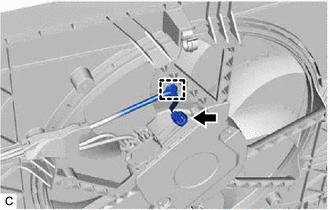
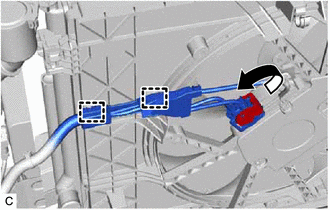
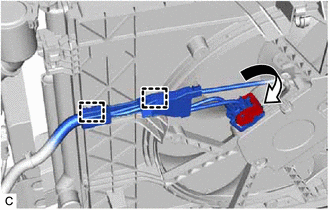
- Disconnect the cooling fan motor connector.
- Disengage the clamp to disconnect the wire harness from the fan with motor assembly.
- Rotate the lever while pushing the lock, and disconnect the cooling fan motor connector.NOTE:
After disconnecting the cooling fan motor connector, make sure that dirt, water or other foreign matter does not contact the connecting parts of the cooling fan motor connector.
- Disengage the 2 clamps to disconnect the wire harness from the fan with motor assembly.
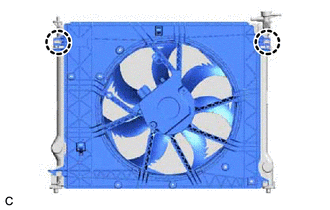
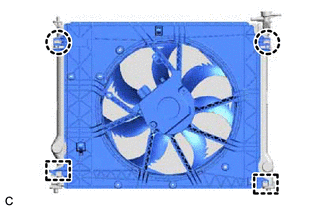
- Disengage the 2 claws and separate the fan with motor assembly from the radiator assembly.
- Clean the radiator assembly.
- Insert the washer nozzle between the radiator assembly and fan with motor assembly and spray the radiator assembly.NOTE:
- Clean the fins of the radiator assembly by spraying the entire area for 150 seconds. Repeat this process twice.
- Set the air pressure to 0.4 MPa (4.1 kgf/cm2 , 58 psi).
- Check that water sprays in mist form from the nozzle.
- Keep the nozzle parallel to the radiator assembly.
- Do not allow the nozzle to contact the fins of the radiator assembly.
- Keep the nozzle moving while spraying water.
- Leave the radiator assembly as is for 10 minutes to let the water penetrate the dirt.
- Clean the radiator assembly again.NOTE:
- Clean the fins of the radiator assembly by spraying the entire area for 150 seconds. Repeat this process 4 times.
- Set the air pressure to 0.4 MPa (4.1 kgf/cm2 , 58 psi).
- Check that water sprays in mist form from the nozzle.
- Keep the nozzle parallel to the radiator assembly.
- Do not allow the nozzle to contact the fins of the radiator assembly.
- Keep the nozzle moving while spraying water.
- Using an air blow gun, dry the radiator assembly for 3 minutes.
- Insert the washer nozzle between the radiator assembly and fan with motor assembly and spray the radiator assembly.
- Check the fins of the radiator assembly for clogs again.
If the radiator assembly is clogged, clean the cooler condenser assembly and radiator assembly again.
- Check that the 2 guides at the bottom are engaged to the radiator assembly.
- Engage the 2 claws to install the fan with motor assembly to the radiator assembly.
- Engage the 2 clamps to connect the wire harness to the fan with motor assembly.
- Connect the cooling fan motor connector and rotate the lever to lock it.NOTE:
- When connecting the cooling fan motor connector, make sure that the connecting parts of the cooling fan motor connector are free of dirt, water and other foreign matter.
- Be sure to securely connect the cooling fan motor connector.
- Engage the clamp to connect the wire harness to the fan with motor assembly.
- Connect the cooling fan motor connector.
- Remove the piece of cloth from the opening of each air duct.
- Install the No. 2 radiator air guide.
See step 8
- Remove the No. 2 radiator air guide.