On-Vehicle Inspection [12/2019 - 11/2023]: Procedure
- CHECK FUEL PUMP OPERATION AND INSPECT FOR FUEL LEAK
- Check fuel pump operation.NOTE:
Do not start the engine.
Powertrain > Engine > Active Test
Tester Display Activate the Circuit Relay - Check for pressure in the fuel tube sub-assembly from the fuel line. Check that sounds of fuel flowing from the fuel tank sub-assembly can be heard. If no sounds can be heard, check the relay, fuel pump, ECM and wiring connectors.
- Inspect for fuel leaks.
- Check that there are no fuel leaks from the fuel system after doing any maintenance or repairs. If there is a fuel leak, repair or replace parts as necessary.
- Check fuel pump operation.
- CHECK FUEL PRESSURE
- Discharge fuel system pressure.
Refer to PRECAUTION [12/2019 - 11/2023]
- Measure the auxiliary battery voltage.
Standard Voltage
11 to 14 V
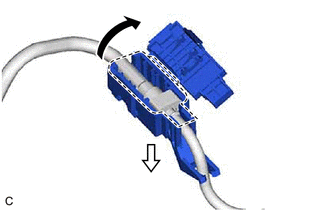
- Open the cover of the EFI fuel pipe clamp and remove the EFI fuel pipe clamp from the fuel tube connector.

Open 
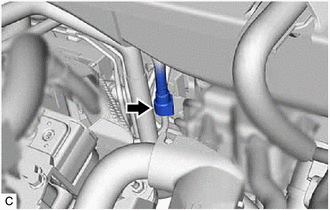
Pull - Disconnect the fuel tube sub-assembly from the fuel pipe.
Refer to PRECAUTION [12/2019 - 11/2023]
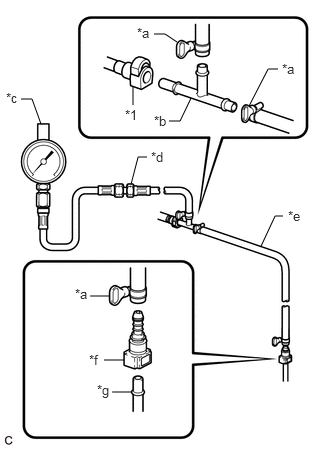
- Install SST (EFI fuel pressure gauge) as shown in the illustration.
*1 Fuel Tube Sub-assembly (Vehicle Side) *a SST (Hose Band) *b SST (T Joint) *c SST (Gauge) *d SST (Hose Joint) *e SST (Hose) *f SST (Fuel Tube Connector) *g Fuel Pipe (Vehicle Side) - SST: 09268-45101
- 09268-41250
- 09268-41260
- 09268-41280
- 09268-41500
- 09268-41700
- 95336-08070
- SST: 09268-45101
- Wipe up any spilled fuel.
- Connect the cable to the negative (-) auxiliary battery terminal.
Refer to PROCEDURE - Step 2
NOTE:When disconnecting the cable, some systems need to be initialized after the cable is reconnected.
Refer to INITIALIZATION [12/2019 - 09/2020] , or refer to INITIALIZATION [09/2020 - 10/2021] , or refer to INITIALIZATION [10/2021 - 10/2022] , or refer to INITIALIZATION [10/2022 - 11/2023]
- Measure the fuel pressure.NOTE:
Do not start the engine.
Powertrain > Engine > Active Test
Tester Display Activate the Circuit Relay Standard Fuel Pressure
294 to 833 kPa (3.0 to 8.5 kgf/cm 2 , 43 to 121 psi)
- If the fuel pressure is more than the standard, replace the fuel main valve assembly.
- If the fuel pressure is less than the standard, check the fuel hoses and their connections, fuel pump and fuel main valve assembly.
- Put the engine in Inspection Mode (Maintenance Mode).
Powertrain > Hybrid Control > Utility
Tester Display Inspection Mode - Start the engine.
- Measure the fuel pressure at idle.
Standard Fuel Pressure
294 to 833 kPa (3.0 to 8.5 kgf/cm 2 , 43 to 121 psi)
HINT:
Refer to Standard Idle Speed.
Refer to PROCEDURE - Step 8
- Disconnect the GTS from the DLC3.
- Stop the engine.
- Check that the fuel pressure remains as specified for 5 minutes.
Standard Fuel Pressure
98 kPa (1.0 kgf/cm 2 , 14.2 psi) or more
If the result is not as specified, check the fuel pump, fuel main valve assembly and/or port fuel injector assemblies.
- After checking the fuel pressure, disconnect the cable from the negative (-) auxiliary battery terminal and carefully remove SST to prevent fuel from spraying.NOTE:
When disconnecting the cable, some systems need to be initialized after the cable is reconnected.
Refer to INITIALIZATION [12/2019 - 09/2020] , or refer to INITIALIZATION [09/2020 - 10/2021] , or refer to INITIALIZATION [10/2021 - 10/2022] , or refer to INITIALIZATION [10/2022 - 11/2023]
- Connect the fuel tube sub-assembly to the fuel pipe.
Refer to PRECAUTION [12/2019 - 11/2023]
- Install the EFI fuel pipe clamp to the fuel tube connector and close the cover of the EFI fuel pipe clamp.
- Connect the cable to the negative (-) auxiliary battery terminal.
Refer to INSTALLATION [12/2019 - 11/2023]
NOTE:When disconnecting the cable, some systems need to be initialized after the cable is reconnected.
Refer to INITIALIZATION [12/2019 - 09/2020] , or refer to INITIALIZATION [09/2020 - 10/2021] , or refer to INITIALIZATION [10/2021 - 10/2022] , or refer to INITIALIZATION [10/2022 - 11/2023]
- Inspect for fuel leaks.
See step 1
- Discharge fuel system pressure.
- CHECK FUEL PRESSURE (for High Pressure)
- Put the engine in Inspection Mode (Maintenance Mode).
Powertrain > Hybrid Control > Utility
Tester Display Inspection Mode - Start the engine and warm it up until the engine coolant temperature is 75°C (167°F) or higher with all the accessories switched off.
Powertrain > Engine > Data List
Tester Display Coolant Temperature - According to the display on the GTS, read the Data List.
Powertrain > Engine > Data List
Tester Display Engine Speed Fuel Pressure (High) Injection Mode HINT:
During charge control, the engine speed is set at idle. Therefore, the engine speed will not increase when the accelerator pedal is depressed. In this case, read the Data List after charge control has completed.
Standard
GTS Display Condition Specified Condition Fuel Pressure (High) - Shift position: P
- A/C: Off
- Engine warmed up
- Engine Speed: 2500 rpm
- Injection Mode: Direct
3000 to 25000 kPa If the result is not as specified, check the fuel pump, fuel pump assembly, fuel pressure sensor and wire harnesses.
- Put the engine in Inspection Mode (Maintenance Mode).