DTC P3004-49: High Voltage Power Resource Circuit Short during Pre-Charge [12/2019 - 11/2023]: Procedure
- CHECK DTC OUTPUT (HYBRID CONTROL, MOTOR GENERATOR)
- Check for DTCs.
Powertrain > Hybrid Control > Trouble Codes
Powertrain > Motor Generator > Trouble Codes
Result
Result Proceed to P3004-49 only is output, or DTCs except the ones in the table below are also output. A DTCs of Hybrid Control System in the tables below are output. B DTCs of Motor Generator Control System in the tables below are output. C Malfunction Content System Relevant DTC Microcomputer malfunction Hybrid Control System P0A1B-49 Drive Motor "A" Control Module Internal Electronic Failure P0606-47 Hybrid/EV Powertrain Control Module Processor Watchdog / Safety MCU Failure P0606-87 Hybrid/EV Powertrain Control Module Processor to Monitoring Processor Missing Message P060A-47 Hybrid/EV Powertrain Control Module Monitoring Processor Watchdog / Safety MCU Failure P060A-87 Hybrid/EV Powertrain Control Module Processor from Monitoring Processor Missing Message P1C9E-9F Hybrid/EV System Reset Stuck Off P0AFC-96 Hybrid/EV Battery Sensor Module Component Internal Failure P0AFC-00 Hybrid/EV Battery Sensor Module Motor Generator Control System P0A1B-1F Generator Control Module Circuit Intermittent P0A1A-47 Generator Control Module Watchdog / Safety MC Failure P0A1A-49 Generator Control Module Internal Electronic Failure P1C2A-1C Generator A/D Converter Circuit Circuit Voltage Out of Range P1C2A-49 Generator A/D Converter Circuit Internal Electronic Failure P3133-83 Communication Error from Generator to Drive Motor "A" Value of Signal Protection Calculation Incorrect P3133-86 Communication Error from Generator to Drive Motor "A" Signal Invalid P3133-87 Communication Error from Generator to Drive Motor "A" Missing Message Power source circuit malfunction Hybrid Control System P0AFC-16 Hybrid/EV Battery Sensor Module Circuit Voltage Below Threshold Motor Generator Control System P06D6-1C Generator Control Module Offset Power Circuit Voltage Out of Range Communication system malfunction Hybrid Control System P3123-87 Lost Communication with Drive Motor Control Module "A" from Hybrid/EV Control Module Missing Message U029A-87 Lost Communication with Hybrid/EV Battery Sensor Module Missing Message Sensor and actuator circuit malfunction Hybrid Control System P0AD9-15 Hybrid/EV Battery Positive Contactor Circuit Short to Auxiliary Battery or Open P0AD9-11 Hybrid/EV Battery Positive Contactor Circuit Short to Ground P0AE4-15 Hybrid/EV Battery Precharge Contactor Circuit Short to Auxiliary Battery or Open P0AE4-11 Hybrid/EV Battery Precharge Contactor Circuit Short to Ground P0ADD-15 Hybrid/EV Battery Negative Contactor Circuit Short to Auxiliary Battery or Open P0ADD-11 Hybrid/EV Battery Negative Contactor Circuit Short to Ground P0ABF-11 Hybrid/EV Battery Current Sensor "A" Circuit Short to Ground P0ABF-15 Hybrid/EV Battery Current Sensor "A" Circuit Short to Auxiliary Battery or Open P0B3B-14 Hybrid/EV Battery Voltage Sensor "A" Circuit Short to Ground or Open P0B40-14 Hybrid/EV Battery Voltage Sensor "B" Circuit Short to Ground or Open P0B45-14 Hybrid/EV Battery Voltage Sensor "C" Circuit Short to Ground or Open P0B4A-14 Hybrid/EV Battery Voltage Sensor "D" Circuit Short to Ground or Open P0B4F-14 Hybrid/EV Battery Voltage Sensor "E" Circuit Short to Ground or Open P0B54-14 Hybrid/EV Battery Voltage Sensor "F" Circuit Short to Ground or Open P0B59-14 Hybrid/EV Battery Voltage Sensor "G" Circuit Short to Ground or Open P0B5E-14 Hybrid/EV Battery Voltage Sensor "H" Circuit Short to Ground or Open P0B63-14 Hybrid/EV Battery Voltage Sensor "I" Circuit Short to Ground or Open P0B68-14 Hybrid/EV Battery Voltage Sensor "J" Circuit Short to Ground or Open P0B6D-14 Hybrid/EV Battery Voltage Sensor "K" Circuit Short to Ground or Open P0B72-14 Hybrid/EV Battery Voltage Sensor "L" Circuit Short to Ground or Open P0B77-14 Hybrid/EV Battery Voltage Sensor "M" Circuit Short to Ground or Open P308A-13 Hybrid/EV Battery Voltage Sensor All Circuit Open P0AFC-62 Hybrid/EV Battery Sensor Module Signal Compare Failure P0B23-1C Hybrid/EV Battery "A" Voltage Sensor Voltage Out of Range P308A-12 Hybrid/EV Battery Voltage Sensor All Circuit Short to Auxiliary Battery P0ABF-00 Hybrid/EV Battery Current Sensor "A" Circuit Range/Performance P0ABF-28 Hybrid/EV Battery Current Sensor "A" Signal Bias Level Out of Range / Zero Adjustment Failure P0ABF-2A Hybrid/EV Battery Current Sensor "A" Signal Stuck In Range System malfunction Hybrid Control System P0C76-00 Hybrid/EV Battery System Discharge Time Too Long P0D2D-1C Drive Motor "A" Inverter Voltage Sensor Voltage Out of Range P1C81-49 High Voltage Power Resource Circuit Consumption Circuit Short P1C82-49 High Voltage Power Resource Circuit Over Loading P1C83-49 High Voltage Power Resource Circuit Voltage Sensor after Boosting Malfunction Motor Generator Control System P0D2D-16 Drive Motor "A" Inverter Voltage Sensor (VH) Circuit Voltage Below Threshold P0D2D-17 Drive Motor "A" Inverter Voltage Sensor (VH) Circuit Voltage Above Threshold P1CB6-9E Drive Motor "A" Inverter Voltage Sensor (VH) Stuck On P0CA3-00 DC/DC Converter Step Up Voltage Performance HINT:
- P3004-49 may be output as a result of the malfunction indicated by the DTCs above.
- The chart above is listed in inspection order of priority.
- Check DTCs that are output at the same time by following the listed order. (The main cause of the malfunction can be determined without performing unnecessary inspections.)
- P3004-49 may be output as a result of the malfunction indicated by the DTCs above.
- Turn the ignition switch off.
Result:
B
GO TO DTC CHART (HYBRID CONTROL SYSTEM)
Refer to DIAGNOSTIC TROUBLE CODE CHART [12/2019 - 09/2020] , or refer to DIAGNOSTIC TROUBLE CODE CHART [09/2020 - 10/2021] , or refer to DIAGNOSTIC TROUBLE CODE CHART [10/2021 - 11/2023]
Result:
C
GO TO DTC CHART (MOTOR GENERATOR CONTROL SYSTEM) . Refer to DIAGNOSTIC TROUBLE CODE CHART [12/2019 - 10/2021] , or refer to DIAGNOSTIC TROUBLE CODE CHART [10/2021 - 11/2023]
Result:
A
See step 2
- Check for DTCs.
- CHECK FREEZE FRAME DATA (HYBRID CONTROL)
- Read the Freeze Frame Data of DTC P3004-49.
Powertrain > Hybrid Control > Trouble Codes
Standard
Freeze Frame Data Specified Condition VH-Voltage after Boosting Below 50 V [*1] Difference between "Hybrid Battery Voltage" and "VL-Voltage before Boosting" -40 to 40 V [*2] Result
Result Cause Proceed to Specified condition [*1] and [*2] are met Inverter system A Except above Other B - Turn the ignition switch off.
Result:
A
REPLACE INVERTER WITH CONVERTER ASSEMBLY
Refer to REMOVAL [12/2019 - 10/2022] , or refer to REMOVAL [10/2022 - 11/2023]
Result:
B
See step 3
- Read the Freeze Frame Data of DTC P3004-49.
- CHECK CONNECTOR CONNECTION CONDITION (HYBRID VEHICLE CONTROL ECU CONNECTOR)
Refer to PROCEDURE - Step 1
Result
Proceed to OK NG Result:
NG
CONNECT SECURELY
Result:
OK
See step 4
- CHECK CONNECTOR CONNECTION CONDITION (FLOOR WIRE CONNECTOR)
Refer to PROCEDURE - Step 5
Result
Result Proceed to OK A NG (The connector is not connected securely.) B NG (The terminals are not making secure contact or are deformed, or water or foreign matter exists in the connector.) C Result:
B
CONNECT SECURELY
Result:
C
REPAIR OR REPLACE HARNESS OR CONNECTOR
Result:
A
See step 5
- CHECK CONNECTOR CONNECTION CONDITION (HV BATTERY JUNCTION BLOCK ASSEMBLY CONNECTOR)
Refer to PROCEDURE - Step 8
Result
Proceed to OK NG Result:
NG
CONNECT SECURELY
Result:
OK
See step 6
- CHECK HARNESS AND CONNECTOR (HYBRID VEHICLE CONTROL ECU - HV BATTERY JUNCTION BLOCK ASSEMBLY) WARNING:
Be sure to wear insulated gloves.
- Check that the service plug grip is not installed.NOTE:
After removing the service plug grip, do not turn the ignition switch to ON (READY), unless instructed by the repair information because this may cause a malfunction.
- Remove the No. 10 HV battery shield panel.
Refer to REMOVAL [12/2019 - 10/2022] , or refer to REMOVAL [10/2022 - 11/2023]
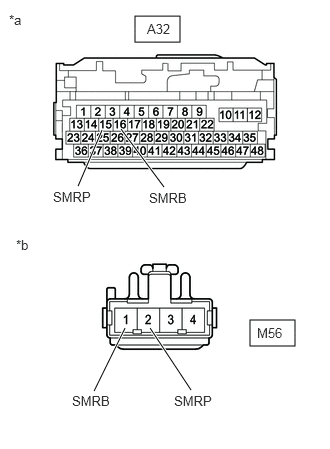
- Disconnect the M56 HV battery junction block assembly connector.
- Disconnect the A32 hybrid vehicle control ECU connector.
- Measure the resistance according to the value(s) in the table below.
Standard Resistance
Tester Connection Condition Specified Condition A32-16 (SMRB) - M56-1 (SMRB) Ignition switch off Below 1 Ω A32-15 (SMRP) - M56-2 (SMRP) Ignition switch off Below 1 Ω *a Front view of wire harness connector
(to Hybrid Vehicle Control ECU)*b Front view of wire harness connector
(to HV Battery Junction Block Assembly) - Reconnect the A32 hybrid vehicle control ECU connector.
- Reconnect the M56 HV battery junction block assembly connector.
- Install the No. 10 HV battery shield panel.
Result
Proceed to OK NG
Result:
NG
REPAIR OR REPLACE HARNESS OR CONNECTOR
Result:
OK
See step 7
- Check that the service plug grip is not installed.
- CHECK HARNESS AND CONNECTOR (HV BATTERY JUNCTION BLOCK ASSEMBLY - BODY GROUND) WARNING:
Be sure to wear insulated gloves.
- Check that the service plug grip is not installed.NOTE:
After removing the service plug grip, do not turn the ignition switch to ON (READY), unless instructed by the repair information because this may cause a malfunction.
- Remove the No. 10 HV battery shield panel.
Refer to REMOVAL [12/2019 - 10/2022] , or refer to REMOVAL [10/2022 - 11/2023]
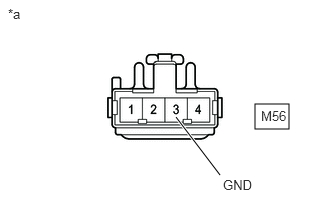
- Disconnect the M56 HV battery junction block assembly connector.
- Measure the resistance according to the value(s) in the table below.
Standard Resistance
Tester Connection Condition Specified Condition M56-3 (GND) - Body ground Ignition switch off Below 1 Ω *a Front view of wire harness connector
(to HV Battery Junction Block Assembly) - Reconnect the M56 HV battery junction block assembly connector.
- Install the No. 10 HV battery shield panel.
Result
Proceed to OK NG
Result:
NG
REPAIR OR REPLACE HARNESS OR CONNECTOR
Result:
OK
See step 8
- Check that the service plug grip is not installed.
- INSPECT HV BATTERY JUNCTION BLOCK ASSEMBLY (SMRB) WARNING:
Be sure to wear insulated gloves.
- Check that the service plug grip is not installed.NOTE:
After removing the service plug grip, do not turn the ignition switch to ON (READY), unless instructed by the repair information because this may cause a malfunction.
- Remove the HV battery junction block assembly.
Refer to REMOVAL [12/2019 - 10/2022] , or refer to REMOVAL [10/2022 - 11/2023]
- Measure the resistance according to the value(s) in the table below.
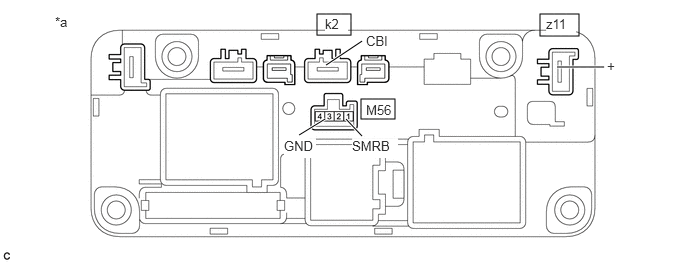
*a Component without harness connected
(HV Battery Junction Block Assembly)- - Standard Resistance
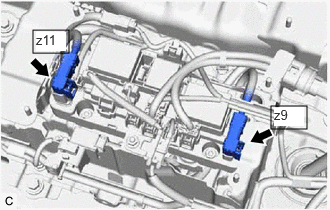
Tester Connection Condition Specified Condition z11-1 (+) - k2-1 (CBI) Auxiliary battery voltage applied between terminals M56-1 (SMRB) and M56-3 (GND) Below 1 Ω - Measure the resistance according to the value(s) in the table below.
Standard Resistance
Tester Connection Condition Specified Condition M56-1 (SMRB) - M56-3 (GND) -40 to 80°C (-40 to 176°F) 25.0 to 59.0 Ω - Install the HV battery junction block assembly.
Result
Proceed to OK NG
Result:
NG
REPLACE HV BATTERY JUNCTION BLOCK ASSEMBLY
Refer to REMOVAL [12/2019 - 10/2022] , or refer to REMOVAL [10/2022 - 11/2023]
Result:
OK
See step 9
- Check that the service plug grip is not installed.
- INSPECT HV BATTERY JUNCTION BLOCK ASSEMBLY (SMRP) WARNING:
Be sure to wear insulated gloves.
- Check that the service plug grip is not installed.NOTE:
After removing the service plug grip, do not turn the ignition switch to ON (READY), unless instructed by the repair information because this may cause a malfunction.
- Remove the HV battery junction block assembly.
Refer to REMOVAL [12/2019 - 10/2022] , or refer to REMOVAL [10/2022 - 11/2023]
- Measure the resistance according to the value(s) in the table below.
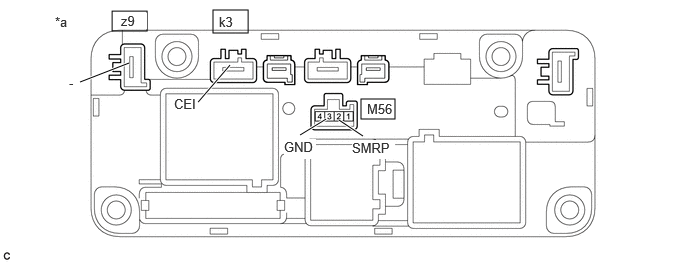
*a Component without harness connected
(HV Battery Junction Block Assembly)- - Standard Resistance
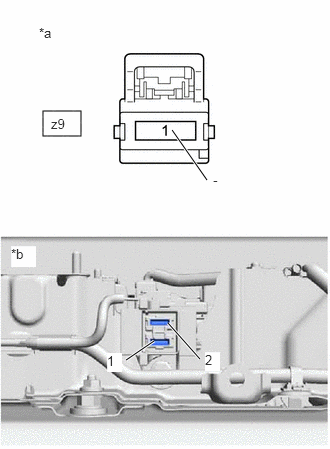
Tester Connection Condition Specified Condition z9-1 (-) - k3-1 (CEI) Auxiliary battery voltage applied between terminals M56-2 (SMRP) and M56-3 (GND) 24.3 to 29.7 Ω - Measure the resistance according to the value(s) in the table below.
Standard Resistance
Tester Connection Condition Specified Condition M56-2 (SMRP) - M56-3 (GND) -40 to 80°C (-40 to 176°F) 140 to 290 Ω - Install the HV battery junction block assembly.
Result
Proceed to OK NG
Result:
NG
REPLACE HV BATTERY JUNCTION BLOCK ASSEMBLY
Refer to REMOVAL [12/2019 - 10/2022] , or refer to REMOVAL [10/2022 - 11/2023]
Result:
OK
See step 10
- Check that the service plug grip is not installed.
- CHECK INVERTER WITH CONVERTER ASSEMBLY (HV FLOOR UNDER WIRE CONNECTION CONDITION) WARNING:
Be sure to wear insulated gloves.
- Check that the service plug grip is not installed.NOTE:
After removing the service plug grip, do not turn the ignition switch to ON (READY), unless instructed by the repair information because this may cause a malfunction.
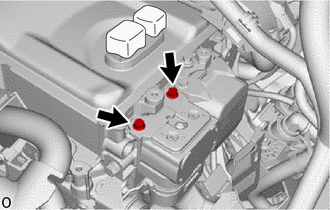
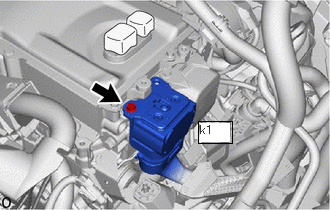
- Check that the bolts for the HV floor under wire are tightened to the specified torque, the HV floor under wire is connected securely, and there are no contact problems.
Specified Condition
T = 8.0 N*m (82 kgf*cm, 71 in.*lbf)
- Disconnect the HV floor under wire from the inverter with converter assembly.
- Check for arc marks on the terminals for the HV floor under wire and inverter with converter assembly.
Result
Result Proceed to The terminals are connected securely and there are no contact problems. There are no arc marks. A The terminals are not connected securely and there is a contact problem. There are arc marks. B The terminals are not connected securely and there is a contact problem. There are no arc marks. C The terminals are connected securely and there are no contact problems. There are arc marks. B - Reconnect the HV floor under wire.
Result:
B
REPLACE MALFUNCTIONING PARTS
Result:
C
CONNECT SECURELY
Result:
A
See step 11
- Check that the service plug grip is not installed.
- CHECK HV BATTERY JUNCTION BLOCK ASSEMBLY (HV FLOOR UNDER WIRE CONNECTION CONDITION) WARNING:
Be sure to wear insulated gloves.
- Check that the service plug grip is not installed.NOTE:
After removing the service plug grip, do not turn the ignition switch to ON (READY), unless instructed by the repair information because this may cause a malfunction.
- Remove the No. 10 HV battery shield panel.
Refer to REMOVAL [12/2019 - 10/2022] , or refer to REMOVAL [10/2022 - 11/2023]
- Check that the HV floor under wire is connected securely, and there are no contact problems.
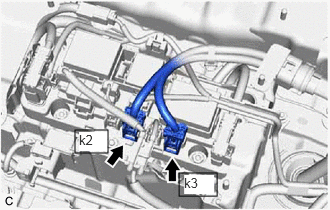
- Disconnect the HV floor under wire connectors from the HV battery junction block assembly.
- Check for arc marks on the terminals of the HV floor under wire and the HV battery junction block assembly.
Result
Result Proceed to The terminals are connected securely and there are no contact problems. There are no arc marks. A The terminals are not connected securely and there is a contact problem. There are arc marks. B The terminals are not connected securely and there is a contact problem. There are no arc marks. C The terminals are connected securely and there are no contact problems. There are arc marks. B - Reconnect the HV floor under wire connectors.
- Install the No. 10 HV battery shield panel.
Result:
B
REPLACE MALFUNCTIONING PARTS
Result:
C
CONNECT SECURELY
Result:
A
See step 12
- Check that the service plug grip is not installed.
- CHECK FLOOR UNDER WIRE WARNING:
Be sure to wear insulated gloves.
- Check that the service plug grip is not installed.NOTE:
After removing the service plug grip, do not turn the ignition switch to ON (READY), unless instructed by the repair information because this may cause a malfunction.
- Remove the No. 10 HV battery shield panel.
Refer to REMOVAL [12/2019 - 10/2022] , or refer to REMOVAL [10/2022 - 11/2023]
- Disconnect the HV floor under wire connectors from the HV battery junction block assembly.
- Disconnect the HV floor under wire connector from the inverter with converter assembly.
- Measure the resistance according to the value(s) in the table below.
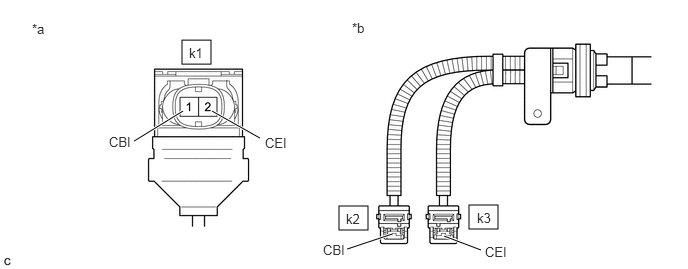
*a HV Floor Under Wire
(Inverter with Converter Assembly Side)*b HV Floor Under Wire
(HV Battery Junction Block Assembly Side)Standard Resistance
Tester Connection Condition Specified Condition k1-1 (CBI) - k2-1 (CBI) Ignition switch off Below 1 Ω k1-2 (CEI) - k3-1 (CEI) Ignition switch off Below 1 Ω NOTE:Be sure not to damage or deform the terminal being inspected.
- Reconnect the HV floor under wire connector to the inverter with converter assembly.
- Reconnect the HV floor under wire connectors to the HV battery junction block assembly.
- Install the No. 10 HV battery shield panel.
Result
Proceed to OK NG
Result:
NG
REPLACE FLOOR UNDER WIRE
Refer to REMOVAL [12/2019 - 10/2022] , or refer to REMOVAL [10/2022 - 11/2023]
Result:
OK
See step 13
- Check that the service plug grip is not installed.
- CHECK HV BATTERY JUNCTION BLOCK ASSEMBLY (HV BATTERY HIGH VOLTAGE CONNECTOR CONNECTION CONDITION) WARNING:
Be sure to wear insulated gloves.
- Check that the service plug grip is not installed.NOTE:
After removing the service plug grip, do not turn the ignition switch to ON (READY), unless instructed by the repair information because this may cause a malfunction.
- Remove the No. 10 HV battery shield panel.
Refer to REMOVAL [12/2019 - 10/2022] , or refer to REMOVAL [10/2022 - 11/2023]
- Check the 2 HV battery high voltage connectors are connected securely, and there are no contact problems.
- Disconnect the 2 HV battery high voltage connectors from the HV battery junction block assembly.
- Check for arc marks on the terminals of the HV battery high voltage connectors and HV battery junction block assembly.
Result
Result Proceed to The terminals are connected securely and there are no contact problems. There are no arc marks. A The terminals are not connected securely and there is a contact problem. There are arc marks. B The terminals are not connected securely and there is a contact problem. There are no arc marks. C The terminals are connected securely and there are no contact problems. There are arc marks. B - Reconnect the 2 HV battery high voltage connectors.
- Install the No. 10 HV battery shield panel.
Result:
B
REPLACE MALFUNCTIONING PARTS
Result:
C
CONNECT SECURELY
Result:
A
See step 14
- Check that the service plug grip is not installed.
- CHECK HV BATTERY HIGH VOLTAGE CABLE WARNING:
Be sure to wear insulated gloves.
- Check that the service plug grip is not installed.NOTE:
After removing the service plug grip, do not turn the ignition switch to ON (READY), unless instructed by the repair information because this may cause a malfunction.
- Remove the No. 10 HV battery shield panel.
Refer to REMOVAL [12/2019 - 10/2022] , or refer to REMOVAL [10/2022 - 11/2023]
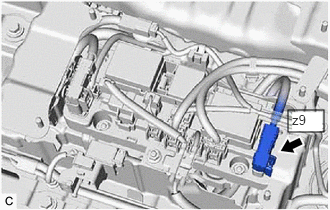
- Disconnect the z9 HV battery high voltage cable connector from the HV battery junction block assembly.NOTE:
Insulate each disconnected high-voltage connector with insulating tape. Wrap the connector from the wire harness side to the end of the connector.
- Measure the resistance according to the value(s) in the table below.
Standard Resistance
Tester Connection Condition Specified Condition z9-1 (-) - Service plug grip connecting terminal 2 Ignition switch off Below 1 Ω *a High Voltage Cable
(HV Battery Junction Block Assembly Side)*b Service Plug Grip Removed
(Service Plug Grip Connecting Terminals) - Reconnect the z9 HV battery high voltage cable connector.
- Install the No. 10 HV battery shield panel.
Result
Proceed to OK NG
Result:
NG
REPLACE HV BATTERY
Refer to REMOVAL [12/2019 - 10/2022] , or refer to REMOVAL [10/2022 - 11/2023]
Result:
OK
See step 15
- Check that the service plug grip is not installed.
- CHECK HYBRID BATTERY TERMINAL BLOCK (HV BATTERY HIGH VOLTAGE CONNECTOR CONNECTION CONDITION) WARNING:
Be sure to wear insulated gloves and protective goggles.
- Check that the service plug grip is not installed.NOTE:
After removing the service plug grip, do not turn the ignition switch to ON (READY), unless instructed by the repair information because this may cause a malfunction.
- Remove the No. 1 hybrid battery shield sub-assembly.
Refer to REMOVAL [12/2019 - 10/2022] , or refer to REMOVAL [10/2022 - 11/2023]
- Check that the 2 HV battery high voltage connectors are connected securely, and there are no contact problems.
- Remove the hybrid battery terminal block.
Refer to REMOVAL [12/2019 - 10/2022] , or refer to REMOVAL [10/2022 - 11/2023]
NOTE:Insulate each disconnected high-voltage connector with insulating tape. Wrap the connector from the wire harness side to the end of the connector.
- Check for arc marks on the terminals of the HV battery high voltage connectors and hybrid battery terminal block.
Result
Result Proceed to The terminals are connected securely and there are no contact problems. There are no arc marks. A The terminals are not connected securely and there is a contact problem. There are arc marks. B The terminals are not connected securely and there is a contact problem. There are no arc marks. C The terminals are connected securely and there are no contact problems. There are arc marks. B - Install the hybrid battery terminal block.
- Install the No. 1 hybrid battery shield sub-assembly.
Result:
B
REPLACE MALFUNCTIONING PARTS
Result:
C
CONNECT SECURELY
Result:
A
See step 16
- Check that the service plug grip is not installed.
- CHECK HV BATTERY HIGH VOLTAGE CABLE WARNING:
Be sure to wear insulated gloves.
- Check that the service plug grip is not installed.NOTE:
After removing the service plug grip, do not turn the ignition switch to ON (READY), unless instructed by the repair information because this may cause a malfunction.
- Remove the No. 1 hybrid battery shield sub-assembly.
Refer to REMOVAL [12/2019 - 10/2022] , or refer to REMOVAL [10/2022 - 11/2023]
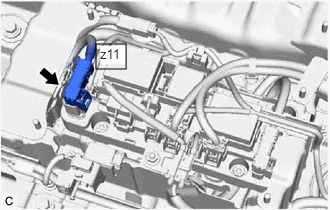
- Disconnect the z11 HV battery high voltage connector from the HV battery junction block assembly.NOTE:
Insulate each disconnected high-voltage connector with insulating tape. Wrap the connector from the wire harness side to the end of the connector.
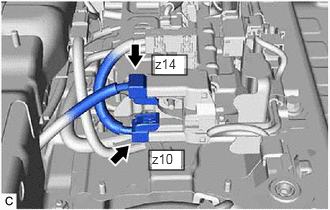
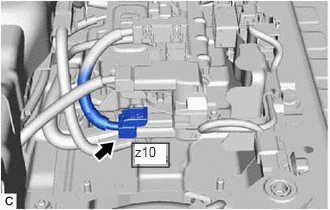
- Disconnect the z10 high voltage connector from the hybrid battery terminal block.NOTE:
Insulate each disconnected high-voltage connector with insulating tape. Wrap the connector from the wire harness side to the end of the connector.
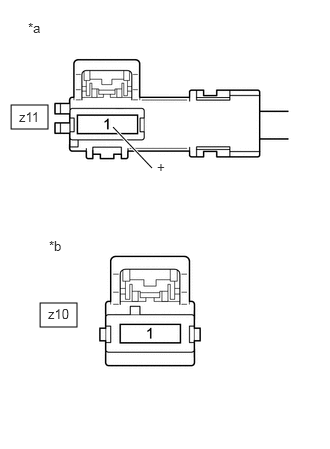
- Measure the resistance according to the value(s) in the table below.
Standard Resistance
Tester Connection Condition Specified Condition z10-1 - z11-1 (+) Ignition switch off Below 1 Ω *a High Voltage Cable
(HV Battery Junction Block Assembly Side)*b High Voltage Cable
(Hybrid Battery Terminal Block Side) - Reconnect the z10 high voltage connector.
- Reconnect the z11 HV battery high voltage connector.
- Install the No. 1 hybrid battery shield sub-assembly.
Result
Proceed to OK NG
Result:
NG
REPLACE HV BATTERY
Refer to REMOVAL [12/2019 - 10/2022] , or refer to REMOVAL [10/2022 - 11/2023]
Result:
OK
See step 17
- Check that the service plug grip is not installed.
- CHECK HYBRID BATTERY TERMINAL BLOCK WARNING:
Be sure to wear insulated gloves and protective goggles.
- Remove the Hybrid battery terminal block.
Refer to REMOVAL [12/2019 - 10/2022] , or refer to REMOVAL [10/2022 - 11/2023]
- Measure the resistance according to the value(s) in the table below.
Standard Resistance
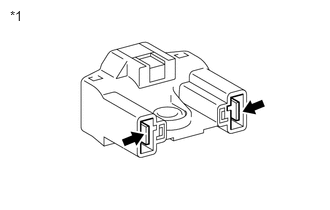
Tester Connection Condition Specified Condition Hybrid battery terminal block Always Below 1 Ω *1 Hybrid Battery Terminal Block - Install the Hybrid battery terminal block.
Result
Proceed to OK NG
Result:
NG
REPLACE HYBRID BATTERY TERMINAL BLOCK
Refer to REMOVAL [12/2019 - 10/2022] , or refer to REMOVAL [10/2022 - 11/2023]
Result:
OK
See step 18
- Remove the Hybrid battery terminal block.
- CHECK HV BATTERY WARNING:
Be sure to wear insulated gloves and protective goggles.
- Check that the service plug grip is not installed.NOTE:
After removing the service plug grip, do not turn the ignition switch to ON (READY), unless instructed by the repair information because this may cause a malfunction.
- Remove the No. 1 hybrid battery shield sub-assembly.
Refer to REMOVAL [12/2019 - 10/2022] , or refer to REMOVAL [10/2022 - 11/2023]
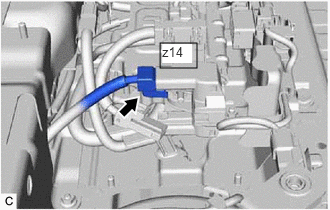
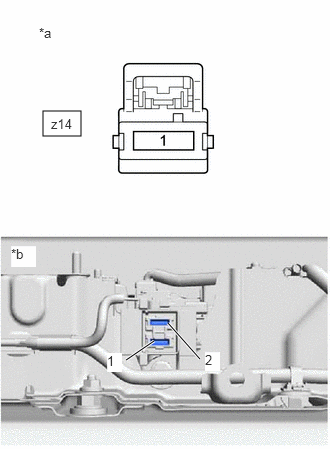
- Disconnect the z14 high voltage connector from the hybrid battery terminal block.NOTE:
Insulate each disconnected high-voltage connector with insulating tape. Wrap the connector from the wire harness side to the end of the connector.
- Measure the voltage according to the value(s) in the table below.
Standard Voltage
Tester Connection Condition Specified Condition z14-1 - Service plug grip connecting terminal 1 Ignition switch off 100 V or higher *a High Voltage Cable
(Hybrid Battery Terminal Block Side)*b Service Plug Grip Removed
(Service Plug Grip Connecting Terminals)WARNING:Do not allow the probes of the electrical tester to contact each other during this inspection.
- Reconnect the z14 high voltage connector to the hybrid battery terminal block.
- Install the No. 1 hybrid battery shield sub-assembly.
Result
Proceed to OK NG
Result:
NG
REPLACE HV BATTERY
Refer to REMOVAL [12/2019 - 10/2022] , or refer to REMOVAL [10/2022 - 11/2023]
Result:
OK
See step 19
- Check that the service plug grip is not installed.
- CHECK FOR INTERMITTENT PROBLEMS
- Check for intermittent problems.
Refer to CHECK FOR INTERMITTENT PROBLEMS [12/2019 - 11/2023]
Result
Result Proceed to Problem symptom does not recur. A Problem symptom recurs. B HINT:
- Since 2 trip detection logic is used, the DTC detection condition must be met twice.
- If DTC P3004-49 is output again after performing the inspection, replace the inverter with converter assembly. If DTC P3004-49 is not output again, replace the HV battery junction block assembly.
Result:
B
REPLACE INVERTER WITH CONVERTER ASSEMBLY
Refer to REMOVAL [12/2019 - 10/2022] , or refer to REMOVAL [10/2022 - 11/2023]
Result:
A
See step 20
- Check for intermittent problems.
- REPLACE HV BATTERY JUNCTION BLOCK ASSEMBLY
Refer to REMOVAL [12/2019 - 10/2022] , or refer to REMOVAL [10/2022 - 11/2023]
Result
Proceed to NEXT Result:
NEXT
See step 21
- CHECK HYBRID VEHICLE CONTROL ECU (CHECK FOR NORMAL OPERATION)
Refer to PROCEDURE - Step 10
Result
Result Proceed to Difference between "Hybrid Battery Voltage" and "VL-Voltage before Boosting" is always less than 50 V. A Difference between "Hybrid Battery Voltage" and "VL-Voltage before Boosting" is 50 V or more. B Result:
A
END
Result:
B
REPLACE HYBRID VEHICLE CONTROL ECU
Refer to REMOVAL [12/2019 - 10/2022] , or refer to REMOVAL [10/2022 - 11/2023]