High Temperature Adjustment [12/2019 - 10/2022]: Procedure
- ADJUST AUTOMATIC TRANSAXLE FLUID LEVEL AT HIGH TEMPERATURE
- Warm up the engine and then turn the ignition switch off.
- Check the automatic transaxle fluid temperature.
Powertrain > Transmission > Data List
Tester Display Engine Speed A/T Oil Temperature No. 1 NOTE:- If the automatic transaxle fluid temperature tends to decrease when the automatic transaxle fluid temperature is between 85°C (185°F) and 90°C (194°F) with the engine idling, make sure that automatic transaxle fluid temperature is above 90°C (194°F) before starting work.
- If the automatic transaxle fluid temperature tends to increase when the automatic transaxle fluid temperature is between 85°C (185°F) and 90°C (194°F) with the engine idling, make sure that automatic transaxle fluid temperature is below 85°C (185°F) before starting work.
- If the automatic transaxle fluid temperature tends not to change when the automatic transaxle fluid temperature is between 85°C (185°F) and 90°C (194°F) with the engine idling, make sure that automatic transaxle fluid temperature is 87.5°C (189.5°F) before starting work.
- Depress and hold the brake pedal.
- Start the engine.
- Slowly move the shift lever from P to D, and then back to P.
HINT:
- Slowly move the shift lever to circulate the automatic transaxle fluid through each part of the automatic transaxle assembly.
- Keep the shift lever in each position for approximately 3 seconds.
- Lift the vehicle.NOTE:
Set the vehicle on a lift so that the vehicle is kept level when it is lifted up (make sure the tilt angle from the front to rear and side to side of the vehicle is within +/- 1°).
- Remove the front wheel opening extension pad LH.
Refer to PROCEDURE - Step 8 [12/2019 - 09/2020] , or refer to PROCEDURE - Step 8 [09/2020 - 10/2022]
- Remove the front wheel opening extension pad RH.
Refer to PROCEDURE - Step 9 [12/2019 - 09/2020] , or refer to PROCEDURE - Step 9 [09/2020 - 10/2022]
- Remove the No. 1 engine under cover.
Refer to PROCEDURE - Step 10 [12/2019 - 09/2020] , or refer to PROCEDURE - Step 10 [09/2020 - 10/2022]
- Remove the rear engine under cover LH.
Refer to PROCEDURE - Step 11 [12/2019 - 09/2020] , or refer to PROCEDURE - Step 11 [09/2020 - 10/2022]
- Remove the front fender apron seal LH.
Refer to PROCEDURE - Step 15 [12/2019 - 09/2020] , or refer to PROCEDURE - Step 15 [09/2020 - 10/2022]
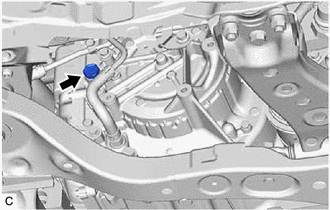
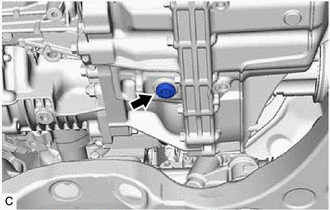
- Remove the refill plug and gasket from the automatic transaxle case sub-assembly.
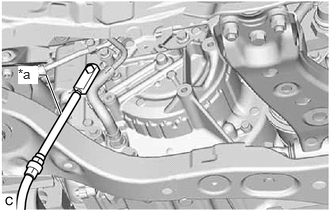
- Install SST (filler plug adapter) to the refill plug hole.
*a SST (Filler Plug Adapter) - SST: 09993-19025
- 09993-10010
- 09993-01030
- SST: 09993-19025
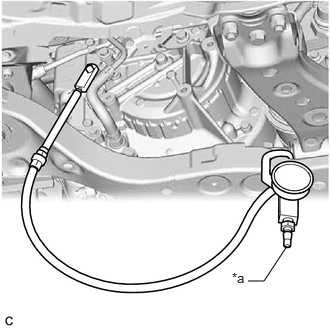
- Connect SST (vacuum regulator) to SST (filler plug adapter).
*a SST (Vacuum Regulator) - SST: 09993-19025
- 09993-10010
- 09993-01020
- SST: 09993-19025
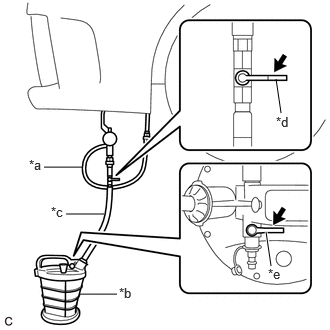
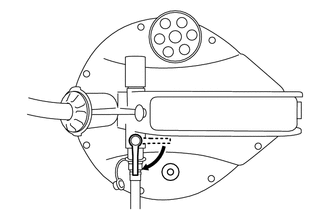
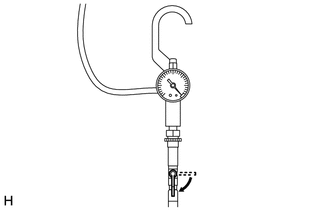
- Connect the hose of SST (tank assy) to SST (vacuum regulator).
*a SST (Vacuum Regulator) *b SST (Tank Assy) *c Hose of SST (Tank Assy) *d Valve Handle (Upper Valve) *e Valve Handle (Lower Valve) - SST: 09993-19025
- 09993-20010
NOTE:Ensure both of the valves of SST (tank assy) are closed by turning the valve handle (upper valve) and valve handle (lower valve) to the position shown in the illustration so they are perpendicular to the hoses.
- SST: 09993-19025
- Connect a compressed air hose to SST (tank assy).NOTE:
Do not apply 689 kPa (7.0 kgf/cm2 , 100 psi) or more of compressed air to SST (tank assy).
- Open the lower valve of SST (tank assy) by turning the valve handle (lower valve) so it is in-line with the compressed air hose.
- Open the upper valve of SST (tank assy) by turning the valve handle (upper valve) so it is in-line with the hose of SST (tank assy).NOTE:
- Make sure to turn the valve handle (upper valve) slowly.
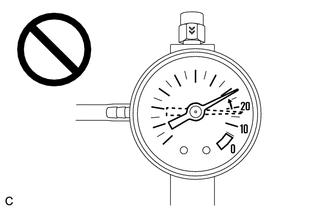
- Make sure the value on the gauge of SST (vacuum regulator) stays between -10 and -20 kPa (-0.1 and -0.2 kgf/cm2 , -1.5 and -2.9 psi).
- If the value on the gauge of SST (vacuum regulator) exceeds -20 kPa (-0.2 kgf/cm2 , -2.9 psi), make sure to turn the valve handle (upper valve) so it is perpendicular to the hose of SST (tank assy) immediately, otherwise parts inside the automatic transaxle assembly may be damaged.
HINT:
Vacuum will be applied to the automatic transaxle assembly when both of the valves of SST (tank assy) are opened to prevent automatic transaxle fluid loss when removing/installing the overflow plug.
- Using a 10 mm hexagon socket wrench, remove the overflow plug and gasket from the transaxle housing.WARNING:
A small amount of hot automatic transaxle fluid may leak from the overflow plug port during removal.
HINT:
Place a container under the overflow plug to collect any automatic transaxle fluid that leaks out.
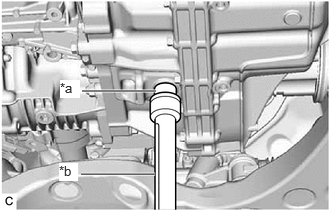
- Install SST (adapter 18) to SST (overflow level gauge) and then install SST (overflow level gauge) to the overflow plug hole by hand until it is fully seated against the transaxle housing.
*a SST (Adapter 18) *b SST (Overflow Level Gauge) - SST: 09993-01100
- SST: 09993-19025
- 09993-10010
- 09993-01010
NOTE:Ensure that the sliding tube of SST (overflow level gauge) is fully retracted into the housing of SST (overflow lever gauge) before inserting it into the overflow plug hole.
HINT:
The level/measurement indicator on SST (overflow level gauge) will read 0 mm (0 in.) when the sliding tube of SST (overflow level gauge) is fully retracted.
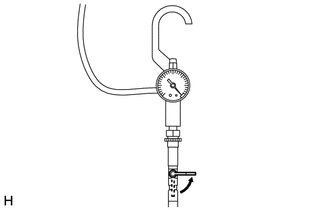
- Adjust SST (overflow level gauge) to the specified measurement according to the table below and lock the sliding scale of SST (overflow level gauge) by tightening the thumb screw.
Specified Measurement
Specified Measurement at Automatic Transaxle Fluid Temperature of 85 to 90°C (185 to 194°F) Engine Idle Speed (rpm) 600 to 700 80 mm (3.15 in.) NOTE:Before proceeding with the inspection, make sure the automatic transaxle fluid temperature is between 85 to 90°C (185 to 194°F) and the engine idle speed is within the specified range in the table above.
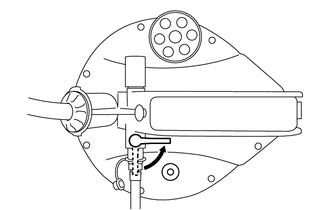
- Close the upper valve of SST (tank assy) by turning the valve handle (upper valve) so it is perpendicular to the hose of SST (tank assy).NOTE:
- Make sure to turn the valve handle (upper valve) slowly.
- Make sure that the gauge of SST (vacuum regulator) reads 0 kPa (0 kgf/cm2 , 0 psi).
HINT:
Vacuum that was applied to the automatic transaxle assembly will not be applied when the valve handle (upper valve) is closed.
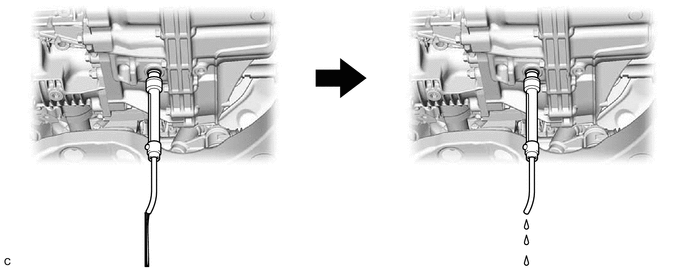
- Check the automatic transaxle fluid flowing from the hose at the bottom of SST (overflow level gauge).
- If the amount of automatic transaxle fluid that comes out of SST (overflow level gauge) is large, proceed to step [#1].
- If no automatic transaxle fluid comes out of SST (overflow level gauge), proceed to step [#2].
- If the amount of automatic transaxle fluid that comes out of SST (overflow level gauge) is large. [#1]
- Wait until the automatic transaxle fluid flow slows and only drips come out.
HINT:
The automatic transaxle fluid flow will not stop completely because the automatic transaxle fluid continues to expand as its temperature increases.
- Open the upper valve of SST (tank assy) by turning the valve handle (upper valve) so it is in-line with the hose of SST (tank assy).NOTE:
- Make sure to turn the valve handle (upper valve) slowly.
- Make sure the value on the gauge of SST (vacuum regulator) stays between -10 and -20 kPa (-0.1 and -0.2 kgf/cm2 , -1.5 and -2.9 psi).
- If the value on the gauge of SST (vacuum regulator) exceeds -20 kPa (-0.2 kgf/cm2 , -2.9 psi), make sure to turn the valve handle (upper valve) so it is perpendicular to the hose of SST (tank assy) immediately, otherwise parts inside the automatic transaxle assembly may be damaged.
HINT:
Vacuum will be applied to the automatic transaxle assembly when both of the valves of SST (tank assy) are opened to prevent automatic transaxle fluid loss when removing/installing the overflow plug.
- Remove SST (overflow level gauge) from the overflow plug hole.
- Using a 10 mm hexagon socket wrench, install the overflow plug and a new gasket to the transaxle housing.
Torque: 50 N.m (510 kgf/cm, 37 ft.lbf)
NOTE:To prevent the gasket from being deformed when tightening, coat it with Toyota Genuine ATF WS.
- Close the upper valve of SST (tank assy) by turning the valve handle (upper valve) so it is perpendicular to the hose of SST (tank assy).NOTE:
- Make sure to turn the valve handle (upper valve) slowly.
- Make sure that the gauge of SST (vacuum regulator) reads 0 kPa (0 kgf/cm2 , 0 psi).
HINT:
Vacuum that was applied to the automatic transaxle assembly will not be applied when the valve handle (upper valve) is closed.
- Close the lower valve of SST (tank assy) by turning the valve handle (lower valve) so it is perpendicular to the compressed air hose.
- Disconnect the compressed air hose from SST (tank assy).
- Disconnect the hose of SST (tank assy) from SST (vacuum regulator).
- Disconnect SST (vacuum regulator) from SST (filler plug adapter).
- Remove SST (filler plug adapter) from the refill plug hole.
- Wait until the automatic transaxle fluid flow slows and only drips come out.
- If no automatic transaxle fluid comes out of SST (overflow level gauge). [#2]
- Remove SST (filler plug adapter) from the refill plug hole.
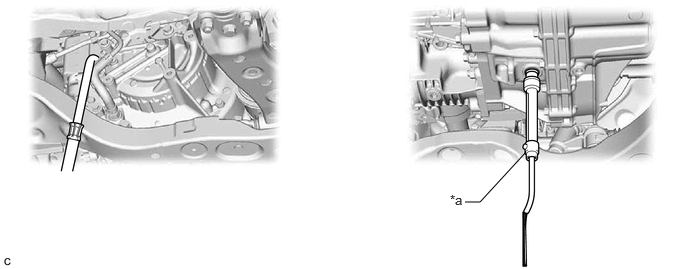
*a SST (Filler Plug Adapter) - Add automatic transaxle fluid through the refill plug hole until fluid comes out of SST (overflow level gauge).
*a SST (Overflow Level Gauge) - - NOTE:Use Toyota Genuine ATF WS.
Using automatic transaxle fluid other than the above type may cause abnormal noise or vibration, or damage the transaxle of the vehicle.
- Wait until the automatic transaxle fluid flow slows and only drips come out.
HINT:
The automatic transaxle fluid flow will not stop completely because the automatic transaxle fluid continues to expand as its temperature increases.
- Install SST (filler plug adapter) to the refill plug hole.
*a SST (Filler Plug Adapter) - SST: 09993-19025
- 09993-10010
- 09993-01030
- SST: 09993-19025
- Open the upper valve of SST (tank assy) by turning the valve handle (upper valve) so it is in-line with the hose of SST (tank assy).NOTE:
- Make sure to turn the valve handle (upper valve) slowly.
- Make sure the value on the gauge of SST (vacuum regulator) stays between -10 and -20 kPa (-0.1 and -0.2 kgf/cm2 , -1.5 and -2.9 psi).
- If the value on the gauge of SST (vacuum regulator) exceeds -20 kPa (-0.2 kgf/cm2 , -2.9 psi), make sure to turn the valve handle (upper valve) so it is perpendicular to the hose of SST (tank assy) immediately, otherwise parts inside the automatic transaxle assembly may be damaged.
HINT:
Vacuum will be applied to the automatic transaxle assembly when both of the valves of SST (tank assy) are opened to prevent automatic transaxle fluid loss when removing/installing the overflow plug.
- Remove SST (overflow level gauge) from the overflow plug hole.
- Using a 10 mm hexagon socket wrench, install the overflow plug and a new gasket to the transaxle housing.
Torque: 50 N.m (510 kgf/cm, 37 ft.lbf)
NOTE:To prevent the gasket from being deformed when tightening, coat it with Toyota Genuine ATF WS.
- Close the upper valve of SST (tank assy) by turning the valve handle (upper valve) so it is perpendicular to the hose of SST (tank assy).NOTE:
- Make sure to turn the valve handle (upper valve) slowly.
- Make sure that the gauge of SST (vacuum regulator) reads 0 kPa (0 kgf/cm2 , 0 psi).
HINT:
Vacuum that was applied to the automatic transaxle assembly will not be applied when the valve handle (upper valve) is closed.
- Close the lower valve of SST (tank assy) by turning the valve handle (lower valve) so it is perpendicular to the compressed air hose.
- Disconnect the compressed air hose from SST (tank assy).
- Disconnect the hose of SST (tank assy) from SST (vacuum regulator).
- Disconnect SST (vacuum regulator) from SST (filler plug adapter).
- Remove SST (filler plug adapter) from the refill plug hole.
- Remove SST (filler plug adapter) from the refill plug hole.
- Install the refill plug and a new gasket to the automatic transaxle case sub-assembly.
Torque: 49 N.m (500 kgf/cm, 36 ft.lbf)
NOTE:To prevent the gasket from being deformed when tightening, coat it with Toyota Genuine ATF WS.
- Disconnect the GTS from the DLC3.
- Lift the vehicle.
- Clean each part.
- Check for automatic transaxle fluid leaks.
- Install the front fender apron seal LH.
Refer to PROCEDURE - Step 74 [12/2019 - 09/2020] , or refer to PROCEDURE - Step 74 [09/2020 - 10/2022]
- Install the rear engine under cover LH.
Refer to PROCEDURE - Step 79 [12/2019 - 09/2020] , or refer to PROCEDURE - Step 79 [09/2020 - 10/2022]
- Install the No. 1 engine under cover.
Refer to PROCEDURE - Step 80 [12/2019 - 09/2020] , or refer to PROCEDURE - Step 80 [09/2020 - 10/2022]
- Install the front wheel opening extension pad LH.
Refer to PROCEDURE - Step 81 [12/2019 - 09/2020] , or refer to PROCEDURE - Step 81 [09/2020 - 10/2022]
- Install the front wheel opening extension pad RH.
Refer to PROCEDURE - Step 82 [12/2019 - 09/2020] , or refer to PROCEDURE - Step 82 [09/2020 - 10/2022]
- Lower the vehicle.